

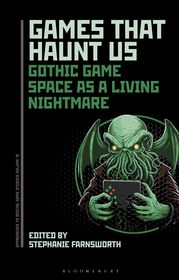
Games That Haunt Us
Gothic Game Space as a Living Nightmare
Sorozatcím: Approaches to Digital Game Studies;
-
20% KEDVEZMÉNY?
- A kedvezmény csak az 'Értesítés a kedvenc témákról' hírlevelünk címzettjeinek rendeléseire érvényes.
- Kiadói listaár GBP 90.00
-
40 635 Ft (38 700 Ft + 5% áfa)
Az ár azért becsült, mert a rendelés pillanatában nem lehet pontosan tudni, hogy a beérkezéskor milyen lesz a forint árfolyama az adott termék eredeti devizájához képest. Ha a forint romlana, kissé többet, ha javulna, kissé kevesebbet kell majd fizetnie.
- Kedvezmény(ek) 20% (cc. 8 127 Ft off)
- Kedvezményes ár 32 508 Ft (30 960 Ft + 5% áfa)
- A kedvezmény érvényes eddig: 2026. június 30.
Iratkozzon fel most és részesüljön kedvezőbb árainkból!
Feliratkozom
40 635 Ft

Beszerezhetőség
Megrendelésre a kiadó utánnyomja a könyvet. Rendelhető, de a szokásosnál kicsit lassabban érkezik meg.
Why don't you give exact delivery time?
A beszerzés időigényét az eddigi tapasztalatokra alapozva adjuk meg. Azért becsült, mert a terméket külföldről hozzuk be, így a kiadó kiszolgálásának pillanatnyi gyorsaságától is függ. A megadottnál gyorsabb és lassabb szállítás is elképzelhető, de mindent megteszünk, hogy Ön a lehető leghamarabb jusson hozzá a termékhez.
A termék adatai:
- Kiadó Bloomsbury Publishing (UK)
- Megjelenés dátuma 2026. március 19.
- Kötetek száma Hardback
- ISBN 9798765124963
- Kötéstípus Keménykötés
- Terjedelem264 oldal
- Méret 218x140x20 mm
- Súly 460 g
- Nyelv angol 680
Kategóriák
Rövid leírás:
An examination of how the Gothic appears in game space to interrogate an area of substantial importance to contemporary games, with a focus on environments, bodies, and defining the Gothic in games.
TöbbHosszú leírás:
Games That Haunt Us: Gothic Game Space as a Living Nightmare is an examination of how the Gothic appears in game space to interrogate an area of substantial importance to contemporary games, with a focus on environments, bodies, and defining the Gothic in games.
The Gothic, both as a literary and videogame genre has increased in prominence amongst literature, media, and culture scholars globally, as games studies becomes a more recognized and exciting field of study and as Gothic scholars find new ways to apply their works across emerging mediums.
But why have Gothic games risen in popularity since 2010? What do players feel when they play these games? Why are themes surrounding fraught identities, mourning, and monstrosity gaining so much attention? Games That Haunt Us investigates the very nature of the Gothic and how video games provide new ways of connecting with the genre. The scholars in this collection look at why Gothic games are having their moment of popularity, the unsettling themes they evoke in unstable times, why we are fascinated with death and decay, theories surrounding body horror, and how games transform avatars and ourselves.
Games That Haunt Us is arranged into three sequential themes: what makes a Gothic game; Gothic environments in game space; and how Gothic bodies are approached and utilized in ludonarratives.
Tartalomjegyzék:
"
List of Contributors
Foreword
Ewan Kirkland
Introduction
Stephanie Farnsworth (University of Sunderland, UK)
Part 1: Defining Gothic Videogames
1. Gothic Epistemology and Space in Metroidvania Games: Navigating Hollow Knight
Jack Orchard (University of Oxford, UK)
2. Scheme-Mother: Exploring Narrative Tension Through Southern and European Gothic Influences in Destiny 2's The Witch Queen
Kira Jones (Emory University, USA)
3. A Matter Not Yours: Gothic Metalepses and Determinist Horror in The Witcher 3: Wild Hunt - Hearts of Stone
Andrin Albrecht (Friedrich-Schiller-University Jena, Germany)
4. Breeding Unease and Distrust through Disruptive Design in Amnesia: A Machine for Pigs
Peter Howell (University of Portsmouth, UK)
Part 2: Gothic Environments and Walking with the Undead
5. The Mourning Tree: Ghosts, Hauntings and Learning to Grieve through Everybody's Gone to the Rapture
Kris Darby (Liverpool Hope, UK)
6. Haunted, Hunted & Harrowed: Resident Evil 2's Police Department Maze of Tension
Eoin Murray (Falmouth University, UK)
7. ""It always ends like this"": Temporality and the Refrain in NieR: Automata
Sian Tomkinson (University of Western Australia)
8. Animals, the Authentic and Gothic Fantasy : the Implicit Moral Mechanics of Killing in The Witcher 3: Wild Hunt
Michael Ru?bsamen (Lund University, Sweden) and Magnus Johansson (Lund University, Sweden)
9. EcoCosmicism: Re-Reading Lovecraft in the Wake of the Climate Crisis
Jemma Morgan (Independent Scholar, UK)
Part 3: Reanimating the Gothic Body through Videogames
10. ""I Want A Girl"": Outlast: Whistleblower, the Feminised Male Protagonist and Intergender Body Horror
Thea Bamber (Roehampton University, UK)
11. ""God Doesn't Love You. Not Like I Do"": Exploring Queer Design, Posthumanism and the Chthulucene in Outlast II
Zarin Rafiuddin (University of Leeds, UK)
12. From Ikkyu to Undertale: A Transnational Development of the Animated Skeleton in Videogames
James T. McCrea (National University, UK)
13. Upgraded models: The demise of the clone in Star Wars: Jedi Fallen Order
Stephanie Farnsworth (University of Sunderland, UK)
14. Uncanny Identities and the Existential Posthuman Gothic in SOMA and The Swapper
Kevin Veale (Massey University, Aotearoa/New Zealand)
Index

