

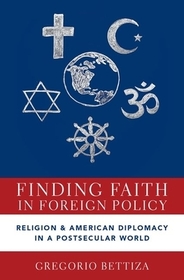
Finding Faith in Foreign Policy
Religion and American Diplomacy in a Postsecular World
-
10% KEDVEZMÉNY?
- A kedvezmény csak az 'Értesítés a kedvenc témákról' hírlevelünk címzettjeinek rendeléseire érvényes.
- Kiadói listaár GBP 72.00
-
32 508 Ft (30 960 Ft + 5% áfa)
Az ár azért becsült, mert a rendelés pillanatában nem lehet pontosan tudni, hogy a beérkezéskor milyen lesz a forint árfolyama az adott termék eredeti devizájához képest. Ha a forint romlana, kissé többet, ha javulna, kissé kevesebbet kell majd fizetnie.
- Kedvezmény(ek) 10% (cc. 3 251 Ft off)
- Kedvezményes ár 29 257 Ft (27 864 Ft + 5% áfa)
Iratkozzon fel most és részesüljön kedvezőbb árainkból!
Feliratkozom
32 508 Ft

Beszerezhetőség
Csak rendelésre kapható a kiadónál, kissé időigényes.
Why don't you give exact delivery time?
A beszerzés időigényét az eddigi tapasztalatokra alapozva adjuk meg. Azért becsült, mert a terméket külföldről hozzuk be, így a kiadó kiszolgálásának pillanatnyi gyorsaságától is függ. A megadottnál gyorsabb és lassabb szállítás is elképzelhető, de mindent megteszünk, hogy Ön a lehető leghamarabb jusson hozzá a termékhez.
A termék adatai:
- Kiadó OUP USA
- Megjelenés dátuma 2019. július 18.
- ISBN 9780190949464
- Kötéstípus Keménykötés
- Terjedelem336 oldal
- Méret 163x239x27 mm
- Súly 612 g
- Nyelv angol 0
Kategóriák
Rövid leírás:
Finding Faith in Foreign Policy comprehensively investigates how American foreign policymakers have come to think about, engage with, and manage religion in world politics across a range of domains since the end of the Cold War and in the aftermath of 9/11. Gregorio Bettiza develops an original theoretical framework and draws upon extensive empirical research and interviews in order to explain policymakers' attempts to promote international religious freedom, deliver aid through faith-based channels, fight terrorism by supporting moderate Muslims and Islam, and engaging religious actors for the purposes of resolving conflicts and finding solutions to current world crises.
TöbbHosszú leírás:
Since the end of the Cold War, religion has become an ever more explicit and systematic focus of US foreign policy across multiple domains. US foreign policymakers, for instance, have been increasingly tasked with monitoring religious freedom and promoting it globally, delivering humanitarian and development aid abroad by drawing on faith-based organizations, fighting global terrorism by seeking to reform Muslim societies and Islamic theologies, and advancing American interests and values more broadly worldwide by engaging with religious actors and dynamics. Simply put, religion has become a major subject and object of American foreign policy in ways that were unimaginable just a few decades ago.
In Finding Faith in Foreign Policy, Gregorio Bettiza explains the causes and consequences of this shift by developing an original theoretical framework and drawing upon extensive empirical research and interviews. He argues that American foreign policy and religious forces have become ever more inextricably entangled in an age witnessing a global resurgence of religion and the emergence of a postsecular world society. He further shows how the boundaries between faith and state have been redefined through processes of desecularization in the context of American foreign policy, leading the most powerful state in the international system to intervene and reshape in increasingly sustained ways sacred and secular landscapes around the globe.
Drawing from a rich evidentiary base spanning twenty-five years, Finding Faith in Foreign Policy details how a wave of religious enthusiasm has transformed not just American foreign policy, but the entire international system.
In a much-needed contribution to the field, Gregorio Bettiza's Finding Faith in Foreign Policy: Religion and American Diplomacy in a Postsecular World offers a systematic means to understand the ascendence of religion as a central theme in American diplomacy after the Cold War.
Tartalomjegyzék:
List of Tables
Abbreviations
Acknowledgments
1. Introduction
2. Theorizing U.S. Foreign Policy in a Postsecular World Society
3. International Religious Freedom
4. Faith-Based Foreign Aid
5. Muslim and Islamic Interventions
6. Religious Engagement
7. Conclusion
Appendix 1. Religious Foreign Policy Regimes' Norms, Ideas, Institutions, and Practices
Appendix 2. List of Interviewees
Bibliography
Index

