

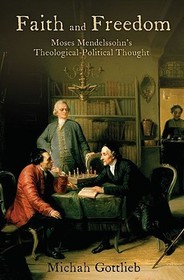
Faith and Freedom
Moses Mendelssohn's Theological-Political Thought
-
10% KEDVEZMÉNY?
- A kedvezmény csak az 'Értesítés a kedvenc témákról' hírlevelünk címzettjeinek rendeléseire érvényes.
- Kiadói listaár GBP 84.00
-
40 131 Ft (38 220 Ft + 5% áfa)
Az ár azért becsült, mert a rendelés pillanatában nem lehet pontosan tudni, hogy a beérkezéskor milyen lesz a forint árfolyama az adott termék eredeti devizájához képest. Ha a forint romlana, kissé többet, ha javulna, kissé kevesebbet kell majd fizetnie.
- Kedvezmény(ek) 10% (cc. 4 013 Ft off)
- Kedvezményes ár 36 118 Ft (34 398 Ft + 5% áfa)
Iratkozzon fel most és részesüljön kedvezőbb árainkból!
Feliratkozom
40 131 Ft

Beszerezhetőség
Megrendelésre a kiadó utánnyomja a könyvet. Rendelhető, de a szokásosnál kicsit lassabban érkezik meg.
Why don't you give exact delivery time?
A beszerzés időigényét az eddigi tapasztalatokra alapozva adjuk meg. Azért becsült, mert a terméket külföldről hozzuk be, így a kiadó kiszolgálásának pillanatnyi gyorsaságától is függ. A megadottnál gyorsabb és lassabb szállítás is elképzelhető, de mindent megteszünk, hogy Ön a lehető leghamarabb jusson hozzá a termékhez.
A termék adatai:
- Kiadó OUP USA
- Megjelenés dátuma 2011. március 10.
- ISBN 9780195398946
- Kötéstípus Keménykötés
- Terjedelem224 oldal
- Méret 163x236x25 mm
- Súly 440 g
- Nyelv angol 0
Kategóriák
Rövid leírás:
Moses Mendelssohn has been cast by some scholars as a Jewish traditionalist who uses enlightened German philosophy to bolster his pre-modern religious beliefs, by others as a radical Deist who defends Judaism in order to avoid opposition from his co-religionists, while facilitating their social integration into enlightened European society. Michah Gottlieb offers a new reading of Mendelssohn's life and writings, arguing that he defends pre-modern Jewish religious concepts sincerely, but unconsciously gives them a humanistic valence appropriate to life in a diverse, enlightened society.
TöbbHosszú leírás:
Two major interpretations of Mendelssohn's achievements have attained prominence in recent works. One interpretation, defended most recently by David Sorkin and Edward Breuer, casts Mendelssohn as a Jewish traditionalist who uses the language of enlightened German philosophy to bolster his pre-modern religious beliefs. The other interpretation, defended by Allan Arkush, casts Mendelssohn as a radical Deist who defends Judaism exoterically in order to avoid arousing opposition from his co-religionists while facilitating their social integration into enlightened European society. In Faith and Freedom, Michah Gottlieb stakes out a middle position. He argues that Mendelssohn defends pre-modern Jewish religious concepts sincerely, but in so doing, unconsciously gives them a humanistic valence appropriate to life in a diverse, enlightened society. Gottlieb sees the Pantheism Controversy as part of a broader assessment of Mendelssohn's theological-political philosophy, framed in terms of Mendelssohn's relation to his two greatest Jewish philosophical predecessors, Moses Maimonides (1138-1204) and Baruch Spinoza (1632-1677).
While Mendelssohn's relation to Maimonides and Spinoza has been discussed sporadically, Faith and Freedom is the first book-length treatment of this subject. The connection is particularly instructive as both Maimonides and Spinoza wrote major theological-political treatises and exercised profound influences on Mendelssohn. Not surprisingly, Mendelssohn is deeply ambivalent about both of these figures. He reveres Maimonides for what he sees as his synthesis of Judaism with secular knowledge, while seeming deeply disturbed by Maimonides's elitism, his equivocation regarding many of the tenets of theism, his espousing religious coercion, and his intolerant view of Gentiles. As for Spinoza, Mendelssohn respects him as a model for how a Jew can fruitfully contribute to science and philosophy and be a model of ethical rectitude. But Mendelssohn objects to Spinoza's atheism, advocacy of state religion, debunking of Jewish chosenness, and rejection of Jewish law.
For Mendelssohn, reason best preserves human dignity and freedom by upholding the individual's right to arrive at truth on their own and determine their own beliefs independently of all authority. As such, reason demands that the state respect diversity of thought and religious expression. Mendelssohn interprets faith in the Jewish sense as trust in God's providential goodness, arguing that reason affirms this as well. But he recognizes the difficulty of establishing metaphysical truth rationally and so in his final works adumbrates a form of religious pragmatism.
The faith-reason debate rages again today. Gottlieb explores Mendelssohn's theological-political thought with an eye to axiological and political dimensions of the debate.
a lucid piece of writing which makes a significant contribution to current Mendelssohn scholarship.
Tartalomjegyzék:
Dedication
Abbreviations
Preface
Introduction
God is Good: The Harmony between Judaism and Enlightenment Philosophy
Philosophy and Law: Shaping Judaism for the Modern World
Either/Or: Jacobi's Attack on the Moderate Enlightenment
Enlightenment Reoriented: Mendelssohn's Pragmatic Religious Idealism
Conclusion
Bibliography

