

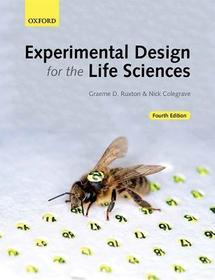
Experimental Design for the Life Sciences
-
10% KEDVEZMÉNY?
- A kedvezmény csak az 'Értesítés a kedvenc témákról' hírlevelünk címzettjeinek rendeléseire érvényes.
- Kiadói listaár GBP 38.99
-
18 627 Ft (17 740 Ft + 5% áfa)
Az ár azért becsült, mert a rendelés pillanatában nem lehet pontosan tudni, hogy a beérkezéskor milyen lesz a forint árfolyama az adott termék eredeti devizájához képest. Ha a forint romlana, kissé többet, ha javulna, kissé kevesebbet kell majd fizetnie.
- Kedvezmény(ek) 10% (cc. 1 863 Ft off)
- Kedvezményes ár 16 764 Ft (15 966 Ft + 5% áfa)
Iratkozzon fel most és részesüljön kedvezőbb árainkból!
Feliratkozom
18 627 Ft

Beszerezhetőség
Megrendelésre a kiadó utánnyomja a könyvet. Rendelhető, de a szokásosnál kicsit lassabban érkezik meg.
Why don't you give exact delivery time?
A beszerzés időigényét az eddigi tapasztalatokra alapozva adjuk meg. Azért becsült, mert a terméket külföldről hozzuk be, így a kiadó kiszolgálásának pillanatnyi gyorsaságától is függ. A megadottnál gyorsabb és lassabb szállítás is elképzelhető, de mindent megteszünk, hogy Ön a lehető leghamarabb jusson hozzá a termékhez.
A termék adatai:
- Kiadás sorszáma 4
- Kiadó OUP Oxford
- Megjelenés dátuma 2016. június 9.
- ISBN 9780198717355
- Kötéstípus Puhakötés
- Terjedelem222 oldal
- Méret 246x193x10 mm
- Súly 390 g
- Nyelv angol
- Illusztrációk 35 b/w illustrations 0
Kategóriák
Rövid leírás:
The only undergraduate textbook devoted to experimental design for the life sciences, making this essential aspect of the research process readily understandable.
TöbbHosszú leírás:
The careful design of experiments lies at the core of good research. Experimental Design for the Life Sciences equips you with the skills you need to effectively design experiments, making this essential aspect of the research process readily understandable. It demonstrates how good experimental design relies on clear thinking and biological understanding, not mathematical or statistical complexity.
With a refreshingly approachable and articulate style, the book walks you through the considerations that go into designing an experiment in clear, practical terms. Using examples drawn from across the life sciences - from ecology, biochemistry, molecular biology, genetics, and health sciences - the authors illustrate how these concepts are applied within the broad context of real biological research.
Online Resources
The online resources to accompany Experimental Design for the Life Sciences feature:
For students:
? Self-test questions and answers
? Additional examples
? Supplementary sections discuss complex concepts and statistical issues in more depth
? Links to useful websites and free software
For lecturers:
? Suggested course structures, complete with practical exercises
? Figures from the book, available to download
Review from previous edition This is an excellent book for learning how to approach the design of experimental and, indeed, observational work. It avoids the usual inclusion of statistical detail that turns many students off while retaining all the key issues that are necessary for planning studies that produce good science. I commend this book to all those who struggle to get students to think seriously about designing good scientific studies.
Tartalomjegyzék:
Why you should care about design
Starting with a well-defined hypothesis
Selecting the broad design of your study
Between-individual variation, replication, and sampling
Pseudoreplication
Sample size, power, and efficient design
The simplest type of experimental design: completely randomized single-factor
Experiments with several factors (factorial designs)
Beyond complete randomization: blocking and covariates
Within-subject designs
Taking measurements

