

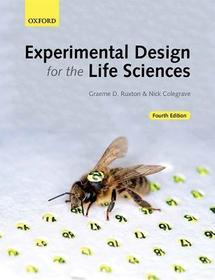
Experimental Design for the Life Sciences
- Publisher's listprice GBP 38.99
-
18 627 Ft (17 740 Ft + 5% VAT)
The price is estimated because at the time of ordering we do not know what conversion rates will apply to HUF / product currency when the book arrives. In case HUF is weaker, the price increases slightly, in case HUF is stronger, the price goes lower slightly.
- Discount 10% (cc. 1 863 Ft off)
- Discounted price 16 764 Ft (15 966 Ft + 5% VAT)
Subcribe now and take benefit of a favourable price.
Subscribe
18 627 Ft

Availability
printed on demand
Why don't you give exact delivery time?
Delivery time is estimated on our previous experiences. We give estimations only, because we order from outside Hungary, and the delivery time mainly depends on how quickly the publisher supplies the book. Faster or slower deliveries both happen, but we do our best to supply as quickly as possible.
Product details:
- Edition number 4
- Publisher OUP Oxford
- Date of Publication 9 June 2016
- ISBN 9780198717355
- Binding Paperback
- No. of pages222 pages
- Size 246x193x10 mm
- Weight 390 g
- Language English
- Illustrations 35 b/w illustrations 0
Categories
Short description:
The only undergraduate textbook devoted to experimental design for the life sciences, making this essential aspect of the research process readily understandable.
MoreLong description:
The careful design of experiments lies at the core of good research. Experimental Design for the Life Sciences equips you with the skills you need to effectively design experiments, making this essential aspect of the research process readily understandable. It demonstrates how good experimental design relies on clear thinking and biological understanding, not mathematical or statistical complexity.
With a refreshingly approachable and articulate style, the book walks you through the considerations that go into designing an experiment in clear, practical terms. Using examples drawn from across the life sciences - from ecology, biochemistry, molecular biology, genetics, and health sciences - the authors illustrate how these concepts are applied within the broad context of real biological research.
Online Resources
The online resources to accompany Experimental Design for the Life Sciences feature:
For students:
? Self-test questions and answers
? Additional examples
? Supplementary sections discuss complex concepts and statistical issues in more depth
? Links to useful websites and free software
For lecturers:
? Suggested course structures, complete with practical exercises
? Figures from the book, available to download
Review from previous edition This is an excellent book for learning how to approach the design of experimental and, indeed, observational work. It avoids the usual inclusion of statistical detail that turns many students off while retaining all the key issues that are necessary for planning studies that produce good science. I commend this book to all those who struggle to get students to think seriously about designing good scientific studies.
Table of Contents:
Why you should care about design
Starting with a well-defined hypothesis
Selecting the broad design of your study
Between-individual variation, replication, and sampling
Pseudoreplication
Sample size, power, and efficient design
The simplest type of experimental design: completely randomized single-factor
Experiments with several factors (factorial designs)
Beyond complete randomization: blocking and covariates
Within-subject designs
Taking measurements

