

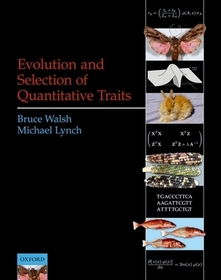
Evolution and Selection of Quantitative Traits
-
10% KEDVEZMÉNY?
- A kedvezmény csak az 'Értesítés a kedvenc témákról' hírlevelünk címzettjeinek rendeléseire érvényes.
- Kiadói listaár GBP 160.00
-
72 240 Ft (68 800 Ft + 5% áfa)
Az ár azért becsült, mert a rendelés pillanatában nem lehet pontosan tudni, hogy a beérkezéskor milyen lesz a forint árfolyama az adott termék eredeti devizájához képest. Ha a forint romlana, kissé többet, ha javulna, kissé kevesebbet kell majd fizetnie.
- Kedvezmény(ek) 10% (cc. 7 224 Ft off)
- Kedvezményes ár 65 016 Ft (61 920 Ft + 5% áfa)
Iratkozzon fel most és részesüljön kedvezőbb árainkból!
Feliratkozom
72 240 Ft

Beszerezhetőség
Becsült beszerzési idő: A Prosperónál jelenleg nincsen raktáron, de a kiadónál igen. Beszerzés kb. 3-5 hét..
A Prosperónál jelenleg nincsen raktáron.
Why don't you give exact delivery time?
A beszerzés időigényét az eddigi tapasztalatokra alapozva adjuk meg. Azért becsült, mert a terméket külföldről hozzuk be, így a kiadó kiszolgálásának pillanatnyi gyorsaságától is függ. A megadottnál gyorsabb és lassabb szállítás is elképzelhető, de mindent megteszünk, hogy Ön a lehető leghamarabb jusson hozzá a termékhez.
A termék adatai:
- Kiadó OUP Oxford
- Megjelenés dátuma 2018. július 12.
- ISBN 9780198830870
- Kötéstípus Keménykötés
- Terjedelem1496 oldal
- Méret 284x223x62 mm
- Súly 3878 g
- Nyelv angol 60
Kategóriák
Rövid leírás:
This is the second volume in a planned trilogy that summarises the modern field of quantitative genetics, informed by empirical observations from wide-ranging fields (agriculture, evolution, ecology, and human biology) as well as population genetics, statistical theory, mathematical modeling, genetics, and genomics.
TöbbHosszú leírás:
Quantitative traits-be they morphological or physiological characters, aspects of behavior, or genome-level features such as the amount of RNA or protein expression for a specific gene-usually show considerable variation within and among populations. Quantitative genetics, also referred to as the genetics of complex traits, is the study of such characters and is based on mathematical models of evolution in which many genes influence the trait and in which non-genetic factors may also be important.
Evolution and Selection of Quantitative Traits presents a holistic treatment of the subject, showing the interplay between theory and data with extensive discussions on statistical issues relating to the estimation of the biologically relevant parameters for these models. Quantitative genetics is viewed as the bridge between complex mathematical models of trait evolution and real-world data, and the authors have clearly framed their treatment as such. This is the second volume in a planned trilogy that summarizes the modern field of quantitative genetics, informed by empirical observations from wide-ranging fields (agriculture, evolution, ecology, and human biology) as well as population genetics, statistical theory, mathematical modeling, genetics, and genomics. Whilst volume 1 (1998) dealt with the genetics of such traits, the main focus of volume 2 is on their evolution, with a special emphasis on detecting selection (ranging from the use of genomic and historical data through to ecological field data) and examining its consequences.
...the authors have done an admirable job at integrating the newest results to provide an unusually current and comprehensive guide. It is hard to imagine that anyone publishing in this area could make the case that they have added to what is known without consulting this wonderful book.
Tartalomjegyzék:
Preface
I
Introduction
Changes in quantitative traits over time
II
Evolution at one and two loci
Neutral evolution in one- and two-locus systems
The genetic effective size of a population
The nonadaptive forces of evolution
The population genetics of selection
Theorems of natural selection: Results of Price, Fisher, and Robertson
Interaction of selection, mutation, and drift
Hitchhiking and selective sweeps
Using molecular data to detect selection: Signatures from recent single events
Using molecular data to detect selection: Signatures from multiple historical events
III
Drift and quantitative traits
Changes in genetic variance induced by drift
The neutral divergence of quantitative traits
IV
Short-term response on a single character
Short-term changes in the mean: 1. The breeder's equation
Short-term changes in the mean: 2. Truncation and threshold selection
Short-term changes in the mean: 3. Permanent versus transient response
Short-term changes in the variance: 1. Changes in the additive variance
Short-term changes in the variance: 2. Changes in environmental variance
Analysis of short-term selection experiments: 1. Least-squares approaches
Analysis of short-term selection experiments: 2. Mixed-model and bayesian approaches
Selection response in natural populations
V
Selection in structured populations
Family-based selection
Associative effects: Competition, social interactions, group and kin selection
Selection under inbreeding
VI
Population-genetic models of trait response
The infinitesimal model and its extensions
Long-term response: 1. Deterministic aspects
Long-term response: 2. Finite population size and mutation
Long-term response: 3. Adaptive walks
Maintenance of quantitative genetic variation
VII
Measuring selection on traits
Individual fitness and the measurement of univariate selecton
Measuring multivariate selection
VIII
Appendices
Diffusion theory
Introduction to Bayesian Analysis
Markov Chain Monte Carlo and Gibbs sampling
Multiple comparisons: Bonferroni corrections, false-discovery rates, and meta-analysis
The geometry of vectors and matrices: Eigenvalues and eigenvectors
Derivatives of vectors and vector-valued functions
Literature Cited
Author Index
Organism and Trait Index
Subject Index

