

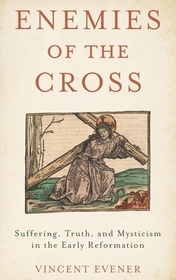
Enemies of the Cross
Suffering, Truth, and Mysticism in the Early Reformation
-
10% KEDVEZMÉNY?
- A kedvezmény csak az 'Értesítés a kedvenc témákról' hírlevelünk címzettjeinek rendeléseire érvényes.
- Kiadói listaár GBP 112.50
-
50 793 Ft (48 375 Ft + 5% áfa)
Az ár azért becsült, mert a rendelés pillanatában nem lehet pontosan tudni, hogy a beérkezéskor milyen lesz a forint árfolyama az adott termék eredeti devizájához képest. Ha a forint romlana, kissé többet, ha javulna, kissé kevesebbet kell majd fizetnie.
- Kedvezmény(ek) 10% (kb. 5 079 Ft)
- Kedvezményes ár 45 714 Ft (43 538 Ft + 5% áfa)
Iratkozzon fel most és részesüljön kedvezőbb árainkból!
Feliratkozom
50 793 Ft

Beszerezhetőség
Becsült beszerzési idő: A Prosperónál jelenleg nincsen raktáron, de a kiadónál igen. Beszerzés kb. 3-5 hét..
A Prosperónál jelenleg nincsen raktáron.
Why don't you give exact delivery time?
A beszerzés időigényét az eddigi tapasztalatokra alapozva adjuk meg. Azért becsült, mert a terméket külföldről hozzuk be, így a kiadó kiszolgálásának pillanatnyi gyorsaságától is függ. A megadottnál gyorsabb és lassabb szállítás is elképzelhető, de mindent megteszünk, hogy Ön a lehető leghamarabb jusson hozzá a termékhez.
A termék adatai:
- Kiadó OUP USA
- Megjelenés dátuma 2021. március 1.
- ISBN 9780190073183
- Kötéstípus Keménykötés
- Terjedelem432 oldal
- Méret 165x239x35 mm
- Súly 748 g
- Nyelv angol 67
Kategóriák
Rövid leírás:
Enemies of the Cross examines how suffering and truth were aligned in the divisive debates of the early Reformation. Vincent Evener draws on seldom-used sources and describes how Protestants and radicals brought medieval mystical teachings into new frameworks that rejected spiritual hierarchy.
TöbbHosszú leírás:
Enemies of the Cross examines how suffering and truth were aligned in the divisive debates of the early Reformation. Vincent Evener explores how Martin Luther, along with his first intra-Reformation critics, offered "true" suffering as a crucible that would allow believers to distinguish the truth or falsehood of doctrine, teachers, and their own experiences. To use suffering in this way, however, reformers also needed to teach Christians to recognize false suffering and the false teachers who hid under its mantle.
This book contends that these arguments, which became an enduring part of the Lutheran and radical traditions, were nourished by the reception of a daring late-medieval mystical tradition — the post-Eckhartian — which depicted annihilation of the self as the way to union with God. The first intra-Reformation dissenters, Andreas Bodenstein von Karlstadt and Thomas Müntzer, have frequently been depicted as champions of medieval mystical views over and against the non-mystical Luther. Evener counters this depiction by showing how Luther, Karlstadt, and Müntzer developed their shared mystical tradition in diverse directions, while remaining united in the conviction that sinful self-assertion prevented human beings from receiving truth and living in union with God. He argues that Luther, Karlstadt, and Müntzer each represented a different form of ecclesial-political dissent shaped by a mystical understanding of how Christians were united to God through the destruction of self-assertion. Enemies of the Cross draws on seldom-used sources and proposes new concepts of "revaluation" and "relocation" to describe how Protestants and radicals brought medieval mystical teachings into new frameworks that rejected spiritual hierarchy.
A notable strength of this book is Evener's detailed examination of each man's intellectual development as witnessed by his successive recorded expressions, of whatever genre.
Tartalomjegyzék:
Acknowledgments
Introduction
1. "No one comes to the living truth except through the way of his nothingness": Mysticism at the Margins of Christendom
2. "I will choose what they ridicule": The Theme of Suffering in Martin Luther's First Theological Protests
3. "To where should he who hopes in God come, unless into his own nothingness?": Mystical Concepts, Transformed Perception, and the Wittenberg Call to the Cross up to 1522
4. "Bring about...that I may become to myself like a bitter boil": Self-Accusation and Sinking into the Divine Will in Karlstadt's Pamphlets, 1522-24
5. The "Bitter Side of Faith": Suffering and Thomas Müntzer's Critique of the Wittenberg Solas, 1517-24
6. "The Cross and the Impossibility of Faith": Suffering and Right Action in a Troubled World, 1524-25
Epilogue
Abbreviations

