

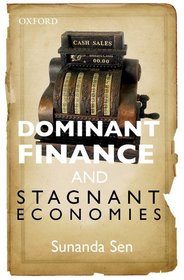
Dominant Finance and Stagnant Economies
-
10% KEDVEZMÉNY?
- A kedvezmény csak az 'Értesítés a kedvenc témákról' hírlevelünk címzettjeinek rendeléseire érvényes.
- Kiadói listaár GBP 112.50
-
53 746 Ft (51 187 Ft + 5% áfa)
Az ár azért becsült, mert a rendelés pillanatában nem lehet pontosan tudni, hogy a beérkezéskor milyen lesz a forint árfolyama az adott termék eredeti devizájához képest. Ha a forint romlana, kissé többet, ha javulna, kissé kevesebbet kell majd fizetnie.
- Kedvezmény(ek) 10% (cc. 5 375 Ft off)
- Kedvezményes ár 48 372 Ft (46 068 Ft + 5% áfa)
Iratkozzon fel most és részesüljön kedvezőbb árainkból!
Feliratkozom
53 746 Ft

Beszerezhetőség
Csak rendelésre kapható a kiadónál, kissé időigényes.
Why don't you give exact delivery time?
A beszerzés időigényét az eddigi tapasztalatokra alapozva adjuk meg. Azért becsült, mert a terméket külföldről hozzuk be, így a kiadó kiszolgálásának pillanatnyi gyorsaságától is függ. A megadottnál gyorsabb és lassabb szállítás is elképzelhető, de mindent megteszünk, hogy Ön a lehető leghamarabb jusson hozzá a termékhez.
A termék adatai:
- Kiadó OUP India
- Megjelenés dátuma 2014. március 13.
- ISBN 9780198095415
- Kötéstípus Keménykötés
- Terjedelem368 oldal
- Méret 223x146x34 mm
- Súly 618 g
- Nyelv angol
- Illusztrációk 28 line drawings and 8 halftones 0
Kategóriák
Rövid leírás:
The book offers an analysis of the current financial crisis and recession in the global economy by relying on an alternative theoretical paradigm which is in line with the Post- Keynesian theoretical frame. It also deals with the problems faced by the developing countries in the context of the global financial crisis.
TöbbHosszú leírás:
Financialization in the world economy has led to massive accumulation as well as concentration of financial assets providing sources of rentier income which has been much higher than those obtainable from physical assets. The present volume attempts to analyse the pattern of financial dominance in the world economy with its links to the systemic crisis. The analysis rests on the theoretical perspectives underlying the Keynesian and the Minskian theoretical framework . This makes the present study of global finance offer a critique of the mainstream neo-liberal doctrine and policies.
The volume consists of a collection of essays, some of which were previously published in journals and edited volumes, and a number of recent papers which are as yet unpublished. These cover a gamut of themes ranging from the paradoxes of loan tying as well as an imminent realisation in lender countries , uncertainty and speculation in commodity markets, the recent global crisis, entry and rise of China in global finance, macro-economic constraints faced by emerging economies like India and China in following a path of autonomous economic policy and inclinations on part of corporates to invest in the high-risk high-return financial assets rather than in assets which generate real activity, output and employment.
The book also dwells on the hegemonic order of the international financial institutions with their iniquitous as well as destabilizing role in the world economy. Spanning the themes as above, the book very successfully demolishes the mainstream 'efficient market' doctrine and its failure in terms of policies, in the advanced as well as in the developing economies.
Tartalomjegyzék:
st of Tables and Figures
Preface
Introduction
Section I Age of Official Capital Flows and Developing Countries
Chapter 1 Tied Loans and Liquidity Constraint
Chapter 2 Dimensions of External Economic Transactions
Section II Global Capital Flows: Paradoxes, Constraints and Asymmetries
Chapter 3 Swings and Paradoxes in International Capital Markets: A Theoretical Note
Chapter 4 International Capital Flows and Global Demand
Chapter 5 Financial Oligarchy in Contemporary Capitalism
Section III Deregulated Global Finance
Chapter 6 Global Finance: On the Move to Stock Market Capitalism
Chapter 7 The Melt-Down of the Global Economy: A Keynes-Minsky Episode
Chapter 8 The Global Crisis and the Remedial Actions: A Non-Mainstream Perspective
Chapter 9 Uncertainty and Speculation in the Keynesian Tradition: Relevance for Commodity Markets
Chapter 10 Does the current crisis remind us of the Great Depression?
Section IV Deregulated Finance in Developing Economies
Chapter 11 Economic Turmoil in Asia: A reinterpretation
Chapter 12 China in the Bull Shop: Dealing with Finance after the WTO
Chapter 13 China in Global Economy: Encountering the Systemic Risks
Chapter 14 Managing Financial Flows at Cost of National Autonomy: China and India
Chapter 15 Managing Finance in Emerging Economies: The Case of India
Chapter 16 Deregulated Finance: Some Concerns for India's Industry and Labour
Index
About the Author

