

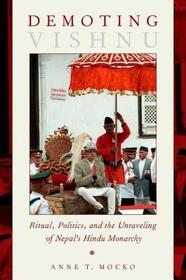
Demoting Vishnu
Ritual, Politics, and the Unraveling of Nepal's Hindu Monarchy
-
10% KEDVEZMÉNY?
- A kedvezmény csak az 'Értesítés a kedvenc témákról' hírlevelünk címzettjeinek rendeléseire érvényes.
- Kiadói listaár GBP 39.99
-
18 055 Ft (17 195 Ft + 5% áfa)
Az ár azért becsült, mert a rendelés pillanatában nem lehet pontosan tudni, hogy a beérkezéskor milyen lesz a forint árfolyama az adott termék eredeti devizájához képest. Ha a forint romlana, kissé többet, ha javulna, kissé kevesebbet kell majd fizetnie.
- Kedvezmény(ek) 10% (kb. 1 806 Ft)
- Kedvezményes ár 16 249 Ft (15 476 Ft + 5% áfa)
Iratkozzon fel most és részesüljön kedvezőbb árainkból!
Feliratkozom
18 055 Ft

Beszerezhetőség
Megrendelésre a kiadó utánnyomja a könyvet. Rendelhető, de a szokásosnál kicsit lassabban érkezik meg.
Why don't you give exact delivery time?
A beszerzés időigényét az eddigi tapasztalatokra alapozva adjuk meg. Azért becsült, mert a terméket külföldről hozzuk be, így a kiadó kiszolgálásának pillanatnyi gyorsaságától is függ. A megadottnál gyorsabb és lassabb szállítás is elképzelhető, de mindent megteszünk, hogy Ön a lehető leghamarabb jusson hozzá a termékhez.
A termék adatai:
- Kiadó OUP USA
- Megjelenés dátuma 2015. december 17.
- ISBN 9780190275228
- Kötéstípus Puhakötés
- Terjedelem258 oldal
- Méret 234x157x20 mm
- Súly 358 g
- Nyelv angol
- Illusztrációk 13 illustrations 0
Kategóriák
Rövid leírás:
Demoting Vishnu examines how the same public ritual that once placed kings at the privileged apex of Nepal's government now in the 21st-century have stopped serving the king, turning instead to authorize party-based politicians.
TöbbHosszú leírás:
At the turn of the millennium, Nepal was the world's last remaining Hindu kingdom: even the most skeptical of observers could hardly imagine that the institution of the monarchy could ever be in jeopardy. In 2001, however, Nepal's popular King Birendra was killed in the royal palace. The crown passed to his brother Gyanendra, but the monarchy would never fully recover. Nepal witnessed an anti-king uprising in April 2006, and over the course of two years, an interim administration systematically took over all the king's duties and privileges. Most decisively, beginning in the summer of 2007, the government began blocking the king from participating in his many public rituals, sending the prime minister in his place instead.
Demoting Vishnu argues that Nepal's dramatic political transformation from monarchy to republic was contested--and in key ways accomplished through--ritual performance. By co-opting state ritual, the king's opponents were able to attack the monarchy's social identity at its foundations, enabling the final legal dissolution of kingship in 2008 to take place without physically harming the king himself. All once-royal rituals continue to be performed, but now they are handled by the country's President--a position created in 2008 to take over state ceremonial functions. Ex-King Gyanendra Shah continues to live in Nepal, is permitted to move about the country and abroad, but is no longer king in any respect.
Mocko's book theorizes the role of public ritual in producing Nepal's state ideology. It examines how royal ritual once authorized kings to serve as the privileged apex of national governance and how, in the 21st-century, those rituals stopped serving the king and began instead to authorize rule by a party-based 'head of state.' Demoting Vishnu illustrates how upheaval in ritual contexts undermined the institutional logic of the monarchy, demonstrating in very public ways that kingship was contingent, opposable, and ultimately dispensable.
excellent case study... The book is an important contribution to the study of ritual dynamics, in general, and thus of interest not only for Nepal scholars.
Tartalomjegyzék:
Acknowledgments
1. Introduction
2. The Rise and Fall of the Shah Dynasty
3. Succession rituals and the 2001 crisis
4. Reinforcement Rituals I: Seeing the Sacred Vest
5. Reinforcement Rituals II: Gaining the Goddess's Blessing
6. Reinforcement Rituals III: Celebrating the Nation's Patriarch
7. Conclusion
Appendix A: Proclamation of the House of Representatives (18 May 2006)
Appendix B: List of Formal Interviews
Appendix C: Glossary of Nepali Terms with Devanagari-Script Equivalents
Bibliography
Index

