

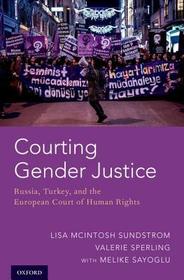
Courting Gender Justice
Russia, Turkey, and the European Court of Human Rights
-
10% KEDVEZMÉNY?
- A kedvezmény csak az 'Értesítés a kedvenc témákról' hírlevelünk címzettjeinek rendeléseire érvényes.
- Kiadói listaár GBP 102.50
-
46 278 Ft (44 075 Ft + 5% áfa)
Az ár azért becsült, mert a rendelés pillanatában nem lehet pontosan tudni, hogy a beérkezéskor milyen lesz a forint árfolyama az adott termék eredeti devizájához képest. Ha a forint romlana, kissé többet, ha javulna, kissé kevesebbet kell majd fizetnie.
- Kedvezmény(ek) 10% (cc. 4 628 Ft off)
- Kedvezményes ár 41 651 Ft (39 668 Ft + 5% áfa)
Iratkozzon fel most és részesüljön kedvezőbb árainkból!
Feliratkozom
46 278 Ft

Beszerezhetőség
Megrendelésre a kiadó utánnyomja a könyvet. Rendelhető, de a szokásosnál kicsit lassabban érkezik meg.
Why don't you give exact delivery time?
A beszerzés időigényét az eddigi tapasztalatokra alapozva adjuk meg. Azért becsült, mert a terméket külföldről hozzuk be, így a kiadó kiszolgálásának pillanatnyi gyorsaságától is függ. A megadottnál gyorsabb és lassabb szállítás is elképzelhető, de mindent megteszünk, hogy Ön a lehető leghamarabb jusson hozzá a termékhez.
A termék adatai:
- Kiadó OUP USA
- Megjelenés dátuma 2019. március 21.
- ISBN 9780190932831
- Kötéstípus Keménykötés
- Terjedelem302 oldal
- Méret 239x157x30 mm
- Súly 544 g
- Nyelv angol 0
Kategóriák
Rövid leírás:
Courting Gender Justice explores the obstacles that confront citizens, activists, and lawyers who try to bring gender discrimination cases to court. Drawing comparisons among forms of discrimination faced by women and LGBT people in Russia and Turkey, the book offers interviews with human rights and feminist activists and lawyers, grounding the law in the personal experiences of individual people fighting to defend their rights.
TöbbHosszú leírás:
Women and the LGBT community in Russia and Turkey face pervasive discrimination. Only a small percentage dare to challenge their mistreatment in court. Facing domestic police and judges who often refuse to recognize discrimination, a small minority of activists have exhausted their domestic appeals and then turned to their last hope: the European Court of Human Rights (ECtHR). The ECtHR, located in Strasbourg, France, is widely regarded as the most effective international human rights court in existence. Russian citizens whose rights have been violated at home have brought tens of thousands of cases to the ECtHR over the past two decades. But only one of these cases resulted in a finding of gender discrimination by the ECtHR-and that case was brought by a man. By comparison, the Court has found gender discrimination more frequently in decisions on Turkish cases. Courting Gender Justice explores the obstacles that confront citizens, activists, and lawyers who try to bring gender discrimination cases to court. To shed light on the factors that make rare victories possible in discrimination cases, the book draws comparisons among forms of discrimination faced by women and LGBT people in Russia and Turkey. Based on interviews with human rights and feminist activists and lawyers in Russia and Turkey, this engaging book grounds the law in the personal experiences of individual people fighting to defend their rights.
By relying on comparative case studies of Russia and Turkey, and making good use of insightful (and on occasion alarming or heart-wrenching) interviews with lawyers, activists, academics and other human rights and feminist practitioners in Russia and Turkey, the authors succeed in presenting a compelling account of how the stark realities on the ground may hinder the effectiveness of the guarantees offered by the echr protection framework ... The key strength of this study is that it offers an accessible, clear and detailed account of activist and victims' perspectives on accessing remedies for discrimination, both in the domestic and the international legal sphere. By focusing primarily on semi-structured interviews, the authors succeed in communicating the immediacy and scale of the problem ... [I]t marks an indispensable and important addition to the literature on Article 14 echr
Tartalomjegyzék:
Table of Cases: European Court of Human Rights
Note on Transliteration
Chapter 1: Gender Discrimination Cases at the European Court of Human Rights: Why So Few?
Chapter 2: What Gender Discrimination? Psychological and Socio-Cultural Barriers
Chapter 3: Police, Prosecutors, and Ping-Pong: Legal Barriers
Chapter 4: Whose Rights are Human Rights? The Gender Gap Between Russian Feminist, LGBT, and Human Rights Networks
Chapter 5: International Obstacles to Russian Gender Discrimination Cases at the European Court of Human Rights
Chapter 6: Turkish Gender Discrimination Cases in Domestic and International Courts
Chapter 7: Conclusion
References
Appendix: Interviews
Index

