

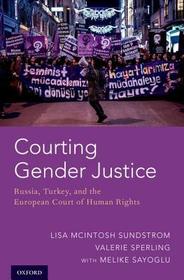
Courting Gender Justice
Russia, Turkey, and the European Court of Human Rights
- Publisher's listprice GBP 102.50
-
46 278 Ft (44 075 Ft + 5% VAT)
The price is estimated because at the time of ordering we do not know what conversion rates will apply to HUF / product currency when the book arrives. In case HUF is weaker, the price increases slightly, in case HUF is stronger, the price goes lower slightly.
- Discount 10% (cc. 4 628 Ft off)
- Discounted price 41 651 Ft (39 668 Ft + 5% VAT)
Subcribe now and take benefit of a favourable price.
Subscribe
46 278 Ft

Availability
printed on demand
Why don't you give exact delivery time?
Delivery time is estimated on our previous experiences. We give estimations only, because we order from outside Hungary, and the delivery time mainly depends on how quickly the publisher supplies the book. Faster or slower deliveries both happen, but we do our best to supply as quickly as possible.
Product details:
- Publisher OUP USA
- Date of Publication 21 March 2019
- ISBN 9780190932831
- Binding Hardback
- No. of pages302 pages
- Size 239x157x30 mm
- Weight 544 g
- Language English 0
Categories
Short description:
Courting Gender Justice explores the obstacles that confront citizens, activists, and lawyers who try to bring gender discrimination cases to court. Drawing comparisons among forms of discrimination faced by women and LGBT people in Russia and Turkey, the book offers interviews with human rights and feminist activists and lawyers, grounding the law in the personal experiences of individual people fighting to defend their rights.
MoreLong description:
Women and the LGBT community in Russia and Turkey face pervasive discrimination. Only a small percentage dare to challenge their mistreatment in court. Facing domestic police and judges who often refuse to recognize discrimination, a small minority of activists have exhausted their domestic appeals and then turned to their last hope: the European Court of Human Rights (ECtHR). The ECtHR, located in Strasbourg, France, is widely regarded as the most effective international human rights court in existence. Russian citizens whose rights have been violated at home have brought tens of thousands of cases to the ECtHR over the past two decades. But only one of these cases resulted in a finding of gender discrimination by the ECtHR-and that case was brought by a man. By comparison, the Court has found gender discrimination more frequently in decisions on Turkish cases. Courting Gender Justice explores the obstacles that confront citizens, activists, and lawyers who try to bring gender discrimination cases to court. To shed light on the factors that make rare victories possible in discrimination cases, the book draws comparisons among forms of discrimination faced by women and LGBT people in Russia and Turkey. Based on interviews with human rights and feminist activists and lawyers in Russia and Turkey, this engaging book grounds the law in the personal experiences of individual people fighting to defend their rights.
By relying on comparative case studies of Russia and Turkey, and making good use of insightful (and on occasion alarming or heart-wrenching) interviews with lawyers, activists, academics and other human rights and feminist practitioners in Russia and Turkey, the authors succeed in presenting a compelling account of how the stark realities on the ground may hinder the effectiveness of the guarantees offered by the echr protection framework ... The key strength of this study is that it offers an accessible, clear and detailed account of activist and victims' perspectives on accessing remedies for discrimination, both in the domestic and the international legal sphere. By focusing primarily on semi-structured interviews, the authors succeed in communicating the immediacy and scale of the problem ... [I]t marks an indispensable and important addition to the literature on Article 14 echr
Table of Contents:
Table of Cases: European Court of Human Rights
Note on Transliteration
Chapter 1: Gender Discrimination Cases at the European Court of Human Rights: Why So Few?
Chapter 2: What Gender Discrimination? Psychological and Socio-Cultural Barriers
Chapter 3: Police, Prosecutors, and Ping-Pong: Legal Barriers
Chapter 4: Whose Rights are Human Rights? The Gender Gap Between Russian Feminist, LGBT, and Human Rights Networks
Chapter 5: International Obstacles to Russian Gender Discrimination Cases at the European Court of Human Rights
Chapter 6: Turkish Gender Discrimination Cases in Domestic and International Courts
Chapter 7: Conclusion
References
Appendix: Interviews
Index

