

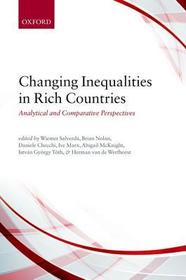
Changing Inequalities in Rich Countries
Analytical and Comparative Perspectives
-
10% KEDVEZMÉNY?
- A kedvezmény csak az 'Értesítés a kedvenc témákról' hírlevelünk címzettjeinek rendeléseire érvényes.
- Kiadói listaár GBP 43.99
-
19 861 Ft (18 915 Ft + 5% áfa)
Az ár azért becsült, mert a rendelés pillanatában nem lehet pontosan tudni, hogy a beérkezéskor milyen lesz a forint árfolyama az adott termék eredeti devizájához képest. Ha a forint romlana, kissé többet, ha javulna, kissé kevesebbet kell majd fizetnie.
- Kedvezmény(ek) 10% (cc. 1 986 Ft off)
- Kedvezményes ár 17 875 Ft (17 024 Ft + 5% áfa)
Iratkozzon fel most és részesüljön kedvezőbb árainkból!
Feliratkozom
19 861 Ft

Beszerezhetőség
Megrendelésre a kiadó utánnyomja a könyvet. Rendelhető, de a szokásosnál kicsit lassabban érkezik meg.
Why don't you give exact delivery time?
A beszerzés időigényét az eddigi tapasztalatokra alapozva adjuk meg. Azért becsült, mert a terméket külföldről hozzuk be, így a kiadó kiszolgálásának pillanatnyi gyorsaságától is függ. A megadottnál gyorsabb és lassabb szállítás is elképzelhető, de mindent megteszünk, hogy Ön a lehető leghamarabb jusson hozzá a termékhez.
A termék adatai:
- Kiadó OUP Oxford
- Megjelenés dátuma 2016. augusztus 18.
- ISBN 9780198784395
- Kötéstípus Puhakötés
- Terjedelem432 oldal
- Méret 233x155x23 mm
- Súly 640 g
- Nyelv angol
- Illusztrációk Figures and Tables 0
Kategóriák
Rövid leírás:
This book uses a combination of comparative analysis and in-depth examination of the experience of 30 countries over the past 30 years, to see whether inequality in incomes, wealth, and education has been widening. It shows how these inequalities are related to social and political outcomes such as poverty, family structures, health, and crime.
TöbbHosszú leírás:
There has been a remarkable upsurge of debate about increasing inequalities and their societal implications, reinforced by the economic crisis but bubbling to the surface before it. This has been seen in popular discourse, media coverage, political debate, and research in the social sciences. The central questions addressed by this book, and the major research project GINI on which it is based, are:
- Have inequalities in income, wealth and education increased over the past 30 years or so across the rich countries, and if so why?
- What are the social, cultural and political impacts of increasing inequalities in income, wealth and education?
- What are the implications for policy and for the future development of welfare states?
In seeking to answer these questions, this book adopts an interdisciplinary approach that draws on economics, sociology, and political science, and applies this approach to learning from the experiences over the last three decades of European countries together with the USA, Japan, Canada, Australia, and South Korea. It combines comparative research with lessons from specific country experiences, and highlights the challenges in seeking to adequately assess the factors underpinning increasing inequalities and to identify the channels through which these may impact on key social and political outcomes, as well as the importance of framing inequality trends and impacts in the institutional and policy context of the country in question.
Tartalomjegyzék:
Preface
Introduction
Increasing Economic Inequalities?
Earnings, Employment, and Income Inequality
Wealth Inequality and the Accumulation of Debt
Increasing Educational Inequalities?
The Social Impact of Income Inequality: Poverty, Deprivation, and Social Cohesion
Social Impacts: Health, Housing, and Inter-generational Mobility
Rising Inequalities: Will Electorates Go for Higher Redistribution?
Inequality, Legitimacy, and the Political System
The Policy Response to Inequality: Redistributing Income
The Policy Response: Employment and Services
The Policy Response to Educational Inequalities
Conclusions

