

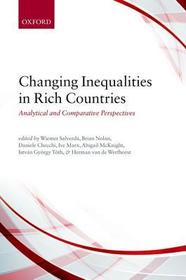
Changing Inequalities in Rich Countries
Analytical and Comparative Perspectives
- Publisher's listprice GBP 43.99
-
19 861 Ft (18 915 Ft + 5% VAT)
The price is estimated because at the time of ordering we do not know what conversion rates will apply to HUF / product currency when the book arrives. In case HUF is weaker, the price increases slightly, in case HUF is stronger, the price goes lower slightly.
- Discount 10% (cc. 1 986 Ft off)
- Discounted price 17 875 Ft (17 024 Ft + 5% VAT)
Subcribe now and take benefit of a favourable price.
Subscribe
19 861 Ft

Availability
printed on demand
Why don't you give exact delivery time?
Delivery time is estimated on our previous experiences. We give estimations only, because we order from outside Hungary, and the delivery time mainly depends on how quickly the publisher supplies the book. Faster or slower deliveries both happen, but we do our best to supply as quickly as possible.
Product details:
- Publisher OUP Oxford
- Date of Publication 18 August 2016
- ISBN 9780198784395
- Binding Paperback
- No. of pages432 pages
- Size 233x155x23 mm
- Weight 640 g
- Language English
- Illustrations Figures and Tables 0
Categories
Short description:
This book uses a combination of comparative analysis and in-depth examination of the experience of 30 countries over the past 30 years, to see whether inequality in incomes, wealth, and education has been widening. It shows how these inequalities are related to social and political outcomes such as poverty, family structures, health, and crime.
MoreLong description:
There has been a remarkable upsurge of debate about increasing inequalities and their societal implications, reinforced by the economic crisis but bubbling to the surface before it. This has been seen in popular discourse, media coverage, political debate, and research in the social sciences. The central questions addressed by this book, and the major research project GINI on which it is based, are:
- Have inequalities in income, wealth and education increased over the past 30 years or so across the rich countries, and if so why?
- What are the social, cultural and political impacts of increasing inequalities in income, wealth and education?
- What are the implications for policy and for the future development of welfare states?
In seeking to answer these questions, this book adopts an interdisciplinary approach that draws on economics, sociology, and political science, and applies this approach to learning from the experiences over the last three decades of European countries together with the USA, Japan, Canada, Australia, and South Korea. It combines comparative research with lessons from specific country experiences, and highlights the challenges in seeking to adequately assess the factors underpinning increasing inequalities and to identify the channels through which these may impact on key social and political outcomes, as well as the importance of framing inequality trends and impacts in the institutional and policy context of the country in question.
Table of Contents:
Preface
Introduction
Increasing Economic Inequalities?
Earnings, Employment, and Income Inequality
Wealth Inequality and the Accumulation of Debt
Increasing Educational Inequalities?
The Social Impact of Income Inequality: Poverty, Deprivation, and Social Cohesion
Social Impacts: Health, Housing, and Inter-generational Mobility
Rising Inequalities: Will Electorates Go for Higher Redistribution?
Inequality, Legitimacy, and the Political System
The Policy Response to Inequality: Redistributing Income
The Policy Response: Employment and Services
The Policy Response to Educational Inequalities
Conclusions

