

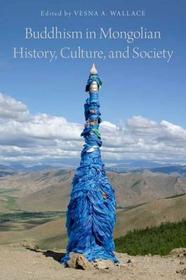
Buddhism in Mongolian History, Culture, and Society
-
10% KEDVEZMÉNY?
- A kedvezmény csak az 'Értesítés a kedvenc témákról' hírlevelünk címzettjeinek rendeléseire érvényes.
- Kiadói listaár GBP 135.00
-
64 496 Ft (61 425 Ft + 5% áfa)
Az ár azért becsült, mert a rendelés pillanatában nem lehet pontosan tudni, hogy a beérkezéskor milyen lesz a forint árfolyama az adott termék eredeti devizájához képest. Ha a forint romlana, kissé többet, ha javulna, kissé kevesebbet kell majd fizetnie.
- Kedvezmény(ek) 10% (cc. 6 450 Ft off)
- Kedvezményes ár 58 047 Ft (55 283 Ft + 5% áfa)
Iratkozzon fel most és részesüljön kedvezőbb árainkból!
Feliratkozom
64 496 Ft

Beszerezhetőség
Megrendelésre a kiadó utánnyomja a könyvet. Rendelhető, de a szokásosnál kicsit lassabban érkezik meg.
Why don't you give exact delivery time?
A beszerzés időigényét az eddigi tapasztalatokra alapozva adjuk meg. Azért becsült, mert a terméket külföldről hozzuk be, így a kiadó kiszolgálásának pillanatnyi gyorsaságától is függ. A megadottnál gyorsabb és lassabb szállítás is elképzelhető, de mindent megteszünk, hogy Ön a lehető leghamarabb jusson hozzá a termékhez.
A termék adatai:
- Kiadó OUP USA
- Megjelenés dátuma 2015. február 19.
- ISBN 9780199958641
- Kötéstípus Keménykötés
- Terjedelem352 oldal
- Méret 163x241x25 mm
- Súly 714 g
- Nyelv angol
- Illusztrációk 18 illus. 0
Kategóriák
Rövid leírás:
Buddhism in Mongolia explores the unique historical and cultural elements of Mongolian Buddhism while challenging its stereotyped image as a mere replica of Tibetan Buddhism. The book illuminates the historical, social, and cultural contexts within which Buddhism has operated as a major social and cultural force among the Mongols.
TöbbHosszú leírás:
Buddhism in Mongolia explores the unique historical and cultural elements of Mongolian Buddhism while challenging its stereotyped image as a mere replica of Tibetan Buddhism. Vesna A. Wallace brings together an interdisciplinary group of leading scholars to explore the interaction between the Mongolian indigenous culture and Buddhism, the features that Buddhism acquired through its adaptation to the Mongolian cultural sphere, and the ways Mongols have been constructing their Mongolian Buddhist identity. In a collection of fifteen chapters, the book illuminates the historical, social, and cultural contexts within which Buddhism has operated as a major social and cultural force among various groups Mongolian ethnic groups.
The volume covers an array of topics pertaining to the important historical events, social and political conditions, and influential personages in Mongolian Buddhism from the sixteenth century to the present. It shows how Buddhism underwent a series of transformations, adapting itself to the social, political, and nomadic cultures of the Mongols.
The contributors demonstrate the ways that Buddhism retained unique Mongolian features through Qing and Mongol support. Most chapters bring to light the ways in which Mongolian Buddhists saw Buddhism as inseparable form "Mongolness". They posit that by being greatly supported by Mongol and Qing empires, suppressed by the communist governments, and experiencing revitalization facilitated by democratization and challenged posed by modernity, Buddhism underwent a series of transformations, while retaining unique Mongolian features.
Wallace covers historical events, social and political conditions, and influential personages in Mongolian Buddhism from the sixteenth century to the present. Buddhism in Mongolia also addresses the artistic and literary expressions of Mongolian Buddhism and various Mongolian Buddhist practices and beliefs.
This volume offers a thoughtful insight into current scholarship on Mongolian Buddhism. It is presented as a variable, non-unified, but yet specific form of Buddhism, which developed in close interaction with indigenous religion and culture.
Tartalomjegyzék:
Acknowledgments
Contributors
Introduction
Vesna A. Wallace
Part I
1. What Happened to Queen Jönggen?
Johan Elverskog
2. The Western Mongolian Clear Script and the Making of the Buddhist State
Richard Taupier
3. Shakur Lama: The Last Attempt to Build the Buddhist State
Baatr Kitinov
4. Modernities, Sense Making, and the Inscription of Mongolian Buddhist Place
Matthew King
5. Envisioning a Mongolian Buddhist Identity through Chinggis Khaan
Vesna A. Wallace
Part II
6. Establishment of the Mergen Tradition of Mongolian Buddhism
Uranchimeg Ujeed
7. Zanabazar (1635-1723): Vajrayana Art and the State in Medieval Mongolia
Uranchimeg Tsultemin
8. The Power and Authority of Maitreya in Mongolia Examined through Mongolian Art
Uranchimeg Tsultemin
9. A Literary History of Buddhism in Mongolia
Simon Wickham-Smith
10. How Vajrapani Became a Mongol
Vesna A. Wallace
11. What Do Protective Deities, Mongolian Heroes, and Fast Steeds Have in Common?
Vesna A. Wallace
12. Buddhist Sacred Mountains, Auspicious Landscapes, and Their Agency
Vesna A. Wallace
Part III
13. Criminal Lamas: Court Cases Against Buddhist Monks in Early Socialist Mongolia
Christopher Kaplonski
14. Transition and Transformation: Buddhist Women of Buryatia
Karma Lekshe Tsomo
15. The Social and Cultural Practices of Buddhism: The Local Context of Inner Mongolia in the First Half of the Twentieth Century
Hurelbaatar Ujeed

