

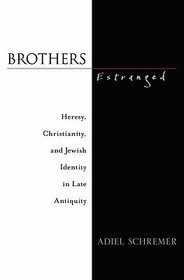
Brothers Estranged
Heresy, Christianity and Jewish Identity in Late Antiquity
-
10% KEDVEZMÉNY?
- A kedvezmény csak az 'Értesítés a kedvenc témákról' hírlevelünk címzettjeinek rendeléseire érvényes.
- Kiadói listaár GBP 100.00
-
45 150 Ft (43 000 Ft + 5% áfa)
Az ár azért becsült, mert a rendelés pillanatában nem lehet pontosan tudni, hogy a beérkezéskor milyen lesz a forint árfolyama az adott termék eredeti devizájához képest. Ha a forint romlana, kissé többet, ha javulna, kissé kevesebbet kell majd fizetnie.
- Kedvezmény(ek) 10% (cc. 4 515 Ft off)
- Kedvezményes ár 40 635 Ft (38 700 Ft + 5% áfa)
Iratkozzon fel most és részesüljön kedvezőbb árainkból!
Feliratkozom
45 150 Ft

Beszerezhetőség
Megrendelésre a kiadó utánnyomja a könyvet. Rendelhető, de a szokásosnál kicsit lassabban érkezik meg.
Why don't you give exact delivery time?
A beszerzés időigényét az eddigi tapasztalatokra alapozva adjuk meg. Azért becsült, mert a terméket külföldről hozzuk be, így a kiadó kiszolgálásának pillanatnyi gyorsaságától is függ. A megadottnál gyorsabb és lassabb szállítás is elképzelhető, de mindent megteszünk, hogy Ön a lehető leghamarabb jusson hozzá a termékhez.
A termék adatai:
- Kiadó OUP USA
- Megjelenés dátuma 2010. február 18.
- ISBN 9780195383775
- Kötéstípus Keménykötés
- Terjedelem296 oldal
- Méret 160x236x25 mm
- Súly 562 g
- Nyelv angol 0
Kategóriák
Rövid leírás:
The emergence of formative Judaism has traditionally been examined in light of a theological preoccupation with the two competing religious movements, 'Christianity' and 'Judaism,' in the first centuries of the Common Era. In this book Ariel Schremer attempts to shift the scholarly consensus away from this paradigm. Relying on the late 20th-century scholarly depiction of the slow and measured growth of Christianity in the empire up until and even after Constantine's conversion, Schremer minimizes the extent to which the rabbis paid attention to the Christian presence. He goes on, however, to pinpoint the parting of the ways between the rabbis and the Christians in the first third of the second century, when Christians were finally assigned to the category of heretics.
TöbbHosszú leírás:
The emergence of formative Judaism has traditionally been examined in light of a theological preoccupation with the two competing religious movements, 'Christianity' and 'Judaism' in the first centuries of the Common Era. In this book Ariel Schremer attempts to shift the scholarly consensus away from this paradigm, instead privileging the rabbinic attitude toward Rome, the destroyer of the temple in 70 C.E., over their concern with the nascent Christian movement. The palpable rabbinic political enmity toward Rome, says Schremer, was determinative in the emerging construction of Jewish self-identity. He asserts that the category of heresy took on a new urgency in the wake of the trauma of the Temple's destruction, which demanded the construction of a new self-identity. Relying on the late 20th-century scholarly depiction of the slow and measured growth of Christianity in the empire up until and even after Constantine's conversion, Schremer minimizes the extent to which the rabbis paid attention to the Christian presence. He goes on, however, to pinpoint the parting of the ways between the rabbis and the Christians in the first third of the second century, when Christians were finally assigned to the category of heretics.
TöbbTartalomjegyzék:
Abbreviations
Editions of rabbinic texts
A note on the translation of rabbinic texts
Introduction
"Where Is Their God?" Destruction, Defeat, and Identity Crisis
Conceptualizing Minut: The Denial of God and the Renunciation of His People
Laws of Minim
Becoming Minut: Labeling the Early Christians as Minim
Christian Belief and Rabbinic Faith
Significant Brothers
Conclusion: A Different Perspective
Notes
Bibliography

