

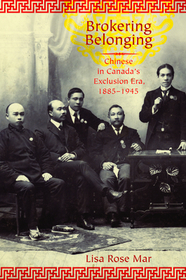
Brokering Belonging
Chinese in Canada's Exclusion Era, 1885-1945
-
10% KEDVEZMÉNY?
- A kedvezmény csak az 'Értesítés a kedvenc témákról' hírlevelünk címzettjeinek rendeléseire érvényes.
- Kiadói listaár GBP 36.99
-
16 700 Ft (15 905 Ft + 5% áfa)
Az ár azért becsült, mert a rendelés pillanatában nem lehet pontosan tudni, hogy a beérkezéskor milyen lesz a forint árfolyama az adott termék eredeti devizájához képest. Ha a forint romlana, kissé többet, ha javulna, kissé kevesebbet kell majd fizetnie.
- Kedvezmény(ek) 10% (kb. 1 670 Ft)
- Kedvezményes ár 15 030 Ft (14 315 Ft + 5% áfa)
Iratkozzon fel most és részesüljön kedvezőbb árainkból!
Feliratkozom
16 700 Ft

Beszerezhetőség
Megrendelésre a kiadó utánnyomja a könyvet. Rendelhető, de a szokásosnál kicsit lassabban érkezik meg.
Why don't you give exact delivery time?
A beszerzés időigényét az eddigi tapasztalatokra alapozva adjuk meg. Azért becsült, mert a terméket külföldről hozzuk be, így a kiadó kiszolgálásának pillanatnyi gyorsaságától is függ. A megadottnál gyorsabb és lassabb szállítás is elképzelhető, de mindent megteszünk, hogy Ön a lehető leghamarabb jusson hozzá a termékhez.
A termék adatai:
- Kiadó OUP USA
- Megjelenés dátuma 2010. december 9.
- ISBN 9780199733149
- Kötéstípus Puhakötés
- Terjedelem240 oldal
- Méret 234x155x17 mm
- Súly 340 g
- Nyelv angol 0
Kategóriák
Rövid leírás:
This fascinating account of Chinatown leaders shows how politics helped establish North America's first major group of illegal immigrants. New Chinese language evidence reveals how ethnic leaders' role as transnational actors and intermediaries both transformed Canadian politics and changed understandings of immigrant communities in a turbulent 20th century.
TöbbHosszú leírás:
Brokering Belonging traces several generations of Chinese "brokers, " ethnic leaders who acted as intermediaries between the Chinese and Anglo worlds of Canada. At the time, most Chinese could not vote and many were illegal immigrants, so brokers played informal but necessary roles as representatives to the larger society. Brokers' work reveals the changing boundaries between Chinese and Anglo worlds, and how tensions among Chinese shaped them.
By reinserting Chinese back into mainstream politics, Brokering Belonging alters common understandings of how legally "alien" groups' helped create modern immigrant nations. Over several generations, brokers deeply embedded Chinese immigrants in the larger Canadian, U.S. and Chinese politics of their time. On the 19th century Western frontier, bilingual Chinese businessmen competed with each other to represent their community. By the early 1920s, a new generation of brokers based in social movements challenged traditional brokers, shifting the power dynamic within the Chinese community. During the Second World War, social movement protests helped reconfigure brokerage relations. By 1947, Chinese had won voting rights in British Columbia and repeal of Canada's Chinese exclusion act.
The history of brokers' work adds new transnational dimensions to many central topics in Canadian, U.S., and Chinese Diaspora history: immigration policy-making, party machines, law, migration, unions, civil rights movements, and the founding of immigration studies. Indeed, Chinese brokers' dealings with researchers from the Chicago School of Sociology had an enduring impact on immigrant scholarship, including beliefs that Asians were a diligent, patient "model minority." Based on new Chinese language evidence, this book recounts history from the ¨middle,' a view that is neither bottom up nor top down. Through brokerage, Chinese wielded considerable influence, navigating a period of anti-Asian sentiment and exclusion throughout society. Consequently, Chinese immigrants became significant players in race relations, influencing policies that affected all Canadians and Americans.
Highly innovative .This study of politics from the middle will shape the way political, immigration, and ethnic historians view power politics.
Tartalomjegyzék:
Introduction
Negotiating Protection: Illegal Immigration and Party Machines
Arguing Cases: Legal Interpreters, Law, and Society
Popularizing Politics: the Anti-Segregation Movement as Social Revolution
Fixing Knowledge: Pacific Coast Chinese Leaders' Management of the Chicago School of Sociology
Transforming Democracy: Brokerage Politics and the Exclusion Era's Denouement
Conclusion
Notes
Bibliography

