

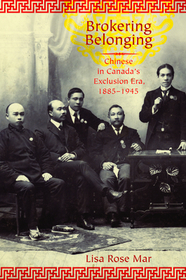
Brokering Belonging
Chinese in Canada's Exclusion Era, 1885-1945
- Publisher's listprice GBP 36.99
-
16 700 Ft (15 905 Ft + 5% VAT)
The price is estimated because at the time of ordering we do not know what conversion rates will apply to HUF / product currency when the book arrives. In case HUF is weaker, the price increases slightly, in case HUF is stronger, the price goes lower slightly.
- Discount 10% (cc. 1 670 Ft off)
- Discounted price 15 030 Ft (14 315 Ft + 5% VAT)
Subcribe now and take benefit of a favourable price.
Subscribe
16 700 Ft

Availability
printed on demand
Why don't you give exact delivery time?
Delivery time is estimated on our previous experiences. We give estimations only, because we order from outside Hungary, and the delivery time mainly depends on how quickly the publisher supplies the book. Faster or slower deliveries both happen, but we do our best to supply as quickly as possible.
Product details:
- Publisher OUP USA
- Date of Publication 9 December 2010
- ISBN 9780199733149
- Binding Paperback
- No. of pages240 pages
- Size 234x155x17 mm
- Weight 340 g
- Language English 0
Categories
Short description:
This fascinating account of Chinatown leaders shows how politics helped establish North America's first major group of illegal immigrants. New Chinese language evidence reveals how ethnic leaders' role as transnational actors and intermediaries both transformed Canadian politics and changed understandings of immigrant communities in a turbulent 20th century.
MoreLong description:
Brokering Belonging traces several generations of Chinese "brokers, " ethnic leaders who acted as intermediaries between the Chinese and Anglo worlds of Canada. At the time, most Chinese could not vote and many were illegal immigrants, so brokers played informal but necessary roles as representatives to the larger society. Brokers' work reveals the changing boundaries between Chinese and Anglo worlds, and how tensions among Chinese shaped them.
By reinserting Chinese back into mainstream politics, Brokering Belonging alters common understandings of how legally "alien" groups' helped create modern immigrant nations. Over several generations, brokers deeply embedded Chinese immigrants in the larger Canadian, U.S. and Chinese politics of their time. On the 19th century Western frontier, bilingual Chinese businessmen competed with each other to represent their community. By the early 1920s, a new generation of brokers based in social movements challenged traditional brokers, shifting the power dynamic within the Chinese community. During the Second World War, social movement protests helped reconfigure brokerage relations. By 1947, Chinese had won voting rights in British Columbia and repeal of Canada's Chinese exclusion act.
The history of brokers' work adds new transnational dimensions to many central topics in Canadian, U.S., and Chinese Diaspora history: immigration policy-making, party machines, law, migration, unions, civil rights movements, and the founding of immigration studies. Indeed, Chinese brokers' dealings with researchers from the Chicago School of Sociology had an enduring impact on immigrant scholarship, including beliefs that Asians were a diligent, patient "model minority." Based on new Chinese language evidence, this book recounts history from the ¨middle,' a view that is neither bottom up nor top down. Through brokerage, Chinese wielded considerable influence, navigating a period of anti-Asian sentiment and exclusion throughout society. Consequently, Chinese immigrants became significant players in race relations, influencing policies that affected all Canadians and Americans.
Highly innovative .This study of politics from the middle will shape the way political, immigration, and ethnic historians view power politics.
Table of Contents:
Introduction
Negotiating Protection: Illegal Immigration and Party Machines
Arguing Cases: Legal Interpreters, Law, and Society
Popularizing Politics: the Anti-Segregation Movement as Social Revolution
Fixing Knowledge: Pacific Coast Chinese Leaders' Management of the Chicago School of Sociology
Transforming Democracy: Brokerage Politics and the Exclusion Era's Denouement
Conclusion
Notes
Bibliography

