

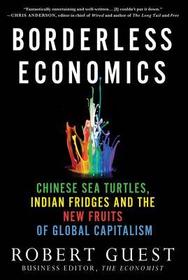
Borderless Economics
Chinese Sea Turtles, Indian Fridges and the New Fruits of Global Capitalism
-
10% KEDVEZMÉNY?
- A kedvezmény csak az 'Értesítés a kedvenc témákról' hírlevelünk címzettjeinek rendeléseire érvényes.
- Kiadói listaár GBP 10.99
-
4 961 Ft (4 725 Ft + 5% áfa)
Az ár azért becsült, mert a rendelés pillanatában nem lehet pontosan tudni, hogy a beérkezéskor milyen lesz a forint árfolyama az adott termék eredeti devizájához képest. Ha a forint romlana, kissé többet, ha javulna, kissé kevesebbet kell majd fizetnie.
- Kedvezmény(ek) 10% (cc. 496 Ft off)
- Kedvezményes ár 4 465 Ft (4 253 Ft + 5% áfa)
Iratkozzon fel most és részesüljön kedvezőbb árainkból!
Feliratkozom
4 961 Ft

Beszerezhetőség
Bizonytalan a beszerezhetőség. Érdemes még egyszer keresni szerzővel és címmel. Ha nem talál másik, kapható kiadást, forduljon ügyfélszolgálatunkhoz!
Why don't you give exact delivery time?
A beszerzés időigényét az eddigi tapasztalatokra alapozva adjuk meg. Azért becsült, mert a terméket külföldről hozzuk be, így a kiadó kiszolgálásának pillanatnyi gyorsaságától is függ. A megadottnál gyorsabb és lassabb szállítás is elképzelhető, de mindent megteszünk, hogy Ön a lehető leghamarabb jusson hozzá a termékhez.
A termék adatai:
- Kiadó Palgrave Macmillan
- Megjelenés dátuma 2011. december 1.
- ISBN 9780230113824
- Kötéstípus Keménykötés
- Terjedelem256 oldal
- Méret 242x161x23 mm
- Súly 423 g
- Nyelv angol 0
Kategóriák
Rövid leírás:
Today, thanks to the ease of technology and travel, we enjoy unprecendented levels of interconnectedness. Societies are increasingly mobile, and immigrant populations maintain strong ties with their native countries, allowing for an unbroken chain of innovation and knowledge that stretches all the way back home. Robert Guest, Global Business Editor for The Economist, shows how today's tribal networks transcend national borders, and how they are shaping the global community in unforeseen ways, including:
*So-called "Chinese sea turtles," young Chinese who come to the West for college before returning to China, eagerly absorb democratic ideals along with their technical training. Now, as they assume leadership positions in Chinese government and business, they will slowly turn China democratic.
*Indian diasporas, having long brought western technology to their home countries, are now bringing Indian technology to the West. They've already developed $70 refrigerators and $2,000 cars; their frugal innovations and managerial know-how are about to turn the global economy on its head.
In a world where trade, trust, and information flow through ethnic networks, the nation that values open borders and encourages the growth of its diaspora populations will be the superpower of the twenty-first century. With on-the-ground reporting from dozens of countries, this is a timely look at the forces greater than national boundaries, and how they can be harnessed to move the whole planet forward.
TöbbHosszú leírás:
Acentury ago, migrants often crossed an ocean and never saw their homelands again. Today, they call - or Skype - home the moment their flight has landed, and that's just the beginning. Thanks to cheap travel and easy communication, immigrants everywhere stay in intimate contact with their native countries, creating powerful cross-border networks.
In Borderless Economics, Robert Guest, The Economist's Business Editor, travels through dozens of countries and 44 American states, observing how these networks create wealth, spread ideas and foster innovation. He shows how:
* Brainy Indians in America collaborate with brainy Indians in India to build $70 fridges and $300 houses
* Young Chinese study in the West and then return home (where they're known as "sea turtles"), infecting China with ideas that will eventually turn it democratic
* The so-called "brain drain" - the flow of educated migrants from poorcountries to rich ones - actually reduces global poverty
*America's unique ability to attract and absorb migrants lets it tap into the energy of all the world's diaspora networks. So despite its current woes, if the United States keeps its borders open, it will remain the world's most powerful nation indefinitely.
With on-the-ground reporting from Asia, Africa, Europe and even Idaho, this book examines how migration, for the all the disruption it causes, makes the world wealthier and happier.
'Optimism is out of fashion at the moment, what with financial crises and joblessness in the headlines, and optimism about (or in) the US is less fashionable still. Into this dour setting, Robert Guest, business editor of The Economist, has arrived in his party clothes. Guest's new book Borderless Economics, is a celebration of the modern upsides of globalisation, immigration and kinship ties. As such, it might be the least fashionable important book to appear in some time.' - Pietra Rivoli, Financial Times
'Guest has produced a book that is witty, rigorous, humane, provocative and dazzlingly well-reported. Everyone should read it. Bravo!' - Tim Harford, author of Adapt and The Undercover Economist
'Fantastically entertaining and well-written…[I] couldn't put it down.' Chris Anderson, Editor-in-Chief of Wired and author of The Long Tail and Free
'An informative, engaging survey of the beneficial consequences of globalization.' Kirkus Reviews
"Robert Guest has discovered the quantum mechanics of economic growth and political liberty. It turns out the wave-particle duality of economic matter and political energy is us. We the people of the world - moving where we want and doing what we will - create the universe of progress. Governments of Earth, say goodbye to the Newtonian concepts of nation and state. The apple of Borderless Economics has hit you on the head and knocked you out." P. J. O'Rourke
'For most, globalization has been about the movement of goods, services, technology and capital. As Robert Guest succinctly explains in this eminently readable book, globalization is actually about people - their migration, the networks they form and the ideas that they transmit through their mobility. In a world grappling with rising protectionist fever, this book is a warning that those nations who want to batten down the hatches and shut the free flow of people and ideas do so at their own risk.' Nandan Nilekani, Chairman, Unique Identification Authority of India
'Too much of economic and political analysis is about countries. Robert Guest shows us the myriad ways in which countries are connected by people who move around to learn, to work and to live. These networks are increasingly central both to the nature of opportunity and to public policy issues in the United States. The book is persuasive: America will stay prosperous and strong only so long as we remain the Hub of the World.' Simon Johnson, co-author, 13 Bankers, and professor at MIT Sloan
"This is a thoughtful, entertaining and above all inspiring hymn of praise to the cultural, social and economic benefits of freer migration. Its conclusion should be noted by every politician running for office: immigration is an opportunity, not a threat."—Bill Emmott, author of 20:21 Vision and Rivals
'A wonderful antidote to the tired and vague clichés about 'globalization'. Drawing on a breadth of research and decades of reporting from 70 countries, Robert Guest makes the case for why global migration is (mostly) an extraordinary force for good.' - Charles Wheelan, author of Naked Economics: Undressing the Dismal Science
'Amusing, intelligent and full of statistics, Borderless Economics is the perfect starting point for exploring new diasporas and international networks.' -LSE Political Blog
'Lucidly written, with a bit of humour thrown in, Robert Guest discusses the issue of migrations and immigrants at a practical level, trying to make politicians see the sense in it.' -Organiser
'This is a superb book...' - Iqbal Quadir, Nature
Tartalomjegyzék:
Diaspora Economics: Why Tribalism Fosters Prosperity
Diaspora Politics: How Sea Turtles Will Turn China Democratic
Networks of Innovation: How Indian Exiles Will Save Medicare
Networks of Trust: How the Brain Drain Reduces Global Poverty
Networks of Hatred: Breeding Jihad and Genocide
The Hub Nation: Why America Will Remain Number One

