

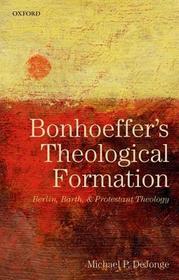
Bonhoeffer's Theological Formation
Berlin, Barth, and Protestant Theology
-
10% KEDVEZMÉNY?
- A kedvezmény csak az 'Értesítés a kedvenc témákról' hírlevelünk címzettjeinek rendeléseire érvényes.
- Kiadói listaár GBP 33.49
-
15 999 Ft (15 237 Ft + 5% áfa)
Az ár azért becsült, mert a rendelés pillanatában nem lehet pontosan tudni, hogy a beérkezéskor milyen lesz a forint árfolyama az adott termék eredeti devizájához képest. Ha a forint romlana, kissé többet, ha javulna, kissé kevesebbet kell majd fizetnie.
- Kedvezmény(ek) 10% (cc. 1 600 Ft off)
- Kedvezményes ár 14 399 Ft (13 713 Ft + 5% áfa)
Iratkozzon fel most és részesüljön kedvezőbb árainkból!
Feliratkozom
15 999 Ft

Beszerezhetőség
Becsült beszerzési idő: A Prosperónál jelenleg nincsen raktáron, de a kiadónál igen. Beszerzés kb. 3-5 hét..
A Prosperónál jelenleg nincsen raktáron.
Why don't you give exact delivery time?
A beszerzés időigényét az eddigi tapasztalatokra alapozva adjuk meg. Azért becsült, mert a terméket külföldről hozzuk be, így a kiadó kiszolgálásának pillanatnyi gyorsaságától is függ. A megadottnál gyorsabb és lassabb szállítás is elképzelhető, de mindent megteszünk, hogy Ön a lehető leghamarabb jusson hozzá a termékhez.
A termék adatai:
- Kiadó OUP Oxford
- Megjelenés dátuma 2018. április 26.
- ISBN 9780198827139
- Kötéstípus Puhakötés
- Terjedelem176 oldal
- Méret 215x141x10 mm
- Súly 242 g
- Nyelv angol 0
Kategóriák
Rövid leírás:
A detailed examination of the academic formation of Dietrich Bonhoeffer's theology, arguing that the young Bonhoeffer reinterpreted for a modern intellectual context the Lutheran understanding of the 'person' of Jesus Christ and distinguishing Bonhoeffer's theology from that of contemporaries Karl Barth and Karl Holl.
TöbbHosszú leírás:
Dietrich Bonhoeffer's dramatic biography, a son of privilege who suffered imprisonment and execution after involving himself in a conspiracy to kill Hitler and overthrow the Third Reich, has helped make him one of the most influential Christian figures of the twentieth century. But before he was known as a martyr or a hero, he was a student and teacher of theology. This book examines the academic formation of Dietrich Bonhoeffer's theology, arguing that the young Bonhoeffer reinterpreted for a modern intellectual context the Lutheran understanding of the 'person' of Jesus Christ. In the process, Bonhoeffer not only distinguished himself from both Karl Barth and Karl Holl, whose dialectical theology and Luther interpretation respectively were two of the most important post-World War I theological movements, but also established the basic character of his own 'person-theology.'
Barth convinces Bonhoeffer that theology must understand revelation as originating outside the human self in God's freedom. But whereas Barth understands revelation as the act of an eternal divine subject, Bonhoeffer treats revelation as the act and being of the historical person of Jesus Christ. On the basis of this person-concept of revelation, Bonhoeffer rejects Barth's dialectical thought, designed to respect the distinction between God and world, for a hermeneutical way of thinking that begins with the reconciliation of God and world in the person of Christ. Here Bonhoeffer mines a Lutheran understanding of the incarnation as God's unreserved entry into history, and the person of Christ as the resulting historical reconciliation of opposites. This also distinguishes Bonhoeffer's Lutheranism from that of Karl Holl, one of Bonhoeffer's teachers in Berlin, whose location of justification in the conscience renders the presence of Christ superfluous. Against this, Bonhoeffer emphasizes the present person of Christ as the precondition of justification. Through these critical conversations, Bonhoeffer develops the features of his person-theology---a person-concept of revelation and a hermeneutical way of thinking---which remain constant despite the sometimes radical changes in his thought.
Tartalomjegyzék:
Between Berlin and Barth
The Problem of Act and Being
The Challenge of Barth's Theology
God is Not Subject but Person: Bonhoeffer's Alternative to Barth
The Lutheran Provenance of Bonhoeffer's Alternative
Evaluating Bonhoeffer's Alternative
Claiming the Lutheran Tradition
The Academic Roots of Bonhoeffer's Ethical Theology
Conclusion

