

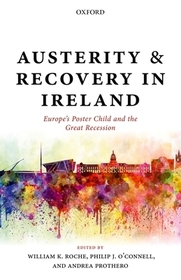
Austerity and Recovery in Ireland
Europe's Poster Child and the Great Recession
-
10% KEDVEZMÉNY?
- A kedvezmény csak az 'Értesítés a kedvenc témákról' hírlevelünk címzettjeinek rendeléseire érvényes.
- Kiadói listaár GBP 107.50
-
51 358 Ft (48 912 Ft + 5% áfa)
Az ár azért becsült, mert a rendelés pillanatában nem lehet pontosan tudni, hogy a beérkezéskor milyen lesz a forint árfolyama az adott termék eredeti devizájához képest. Ha a forint romlana, kissé többet, ha javulna, kissé kevesebbet kell majd fizetnie.
- Kedvezmény(ek) 10% (cc. 5 136 Ft off)
- Kedvezményes ár 46 222 Ft (44 021 Ft + 5% áfa)
Iratkozzon fel most és részesüljön kedvezőbb árainkból!
Feliratkozom
51 358 Ft

Beszerezhetőség
Megrendelésre a kiadó utánnyomja a könyvet. Rendelhető, de a szokásosnál kicsit lassabban érkezik meg.
Why don't you give exact delivery time?
A beszerzés időigényét az eddigi tapasztalatokra alapozva adjuk meg. Azért becsült, mert a terméket külföldről hozzuk be, így a kiadó kiszolgálásának pillanatnyi gyorsaságától is függ. A megadottnál gyorsabb és lassabb szállítás is elképzelhető, de mindent megteszünk, hogy Ön a lehető leghamarabb jusson hozzá a termékhez.
A termék adatai:
- Kiadó OUP Oxford
- Megjelenés dátuma 2016. december 15.
- ISBN 9780198792376
- Kötéstípus Keménykötés
- Terjedelem370 oldal
- Méret 242x172x24 mm
- Súly 705 g
- Nyelv angol
- Illusztrációk 62 Figures, 36 Tables 0
Kategóriák
Rövid leírás:
This book presents a systematic analysis of the Great Recession, austerity, and subsequent recovery in Ireland. It discusses the extent to which the Irish response to the recession led to significant changes in economic policy and in business, work, consumption, the labour market, and society.
TöbbHosszú leírás:
In international commentary and debate on the effects of the Great Recession and austerity, Ireland has been hailed as the poster child for economic recovery and regeneration out of deep economic and fiscal contraction. While the genesis of Ireland's financial, economic and fiscal crisis has been covered in the literature, no systematic analysis has yet been devoted to the period of austerity, to the impact of austerity on institutions and people, or to the roots of economic recovery.
In this book a group of Ireland's leading social scientists present a multi-disciplinary analysis of recession and austerity and their effects on economic, business, political and social life. Individual chapters discuss the fiscal and economic policies implemented, the role of international, and, in particular, of EU institutions, and the effects on businesses, consumption, work, the labour market, migration, political and financial institutions, social inequality and cohesion, housing and cultural expression.
The book shows that Ireland cannot be viewed uncritically as a poster child for austerity. While fiscal contraction provided a basis for stabilizing the perilous finances of the State, economic recovery was due in the main to the long-established structure of Irish economic and business activity, to the importance of foreign direct investment and the dynamic export sector, and to recovery in the international economy. The restructuring and recovery of the financial system was aided by favourable international developments, including historically low interest rates and quantitative easing. Migration flows, nominal wage stability, the protection of social transfer payments and the involvement of trade unions in severe public sector retrenchment - long-established features of Irish political economy - were of critical importance in the maintenance of social cohesion.
The many strands of ruin and gradual but not complete recovery are dealt with in a style that is both scholarly and accessible. This richness makes it the best overall single-volume assessment of our recent political and social experience.
Tartalomjegyzék:
'Poster Child' or 'Beautiful Freak': Austerity and Recovery in Ireland
The Road to Austerity
Economic and Fiscal Policy
Business
The Financial Sector
Banking Regulation
Consumption
Ireland and the 'GIPS' Countries
Political Reform
International Actors and Agencies
Workplaces
Public Service Reform
Unemployment and Labour Market Policy
Inequality
Housing
Migration
Culture

