

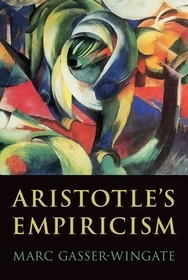
Aristotle's Empiricism
-
10% KEDVEZMÉNY?
- A kedvezmény csak az 'Értesítés a kedvenc témákról' hírlevelünk címzettjeinek rendeléseire érvényes.
- Kiadói listaár GBP 78.00
-
35 217 Ft (33 540 Ft + 5% áfa)
Az ár azért becsült, mert a rendelés pillanatában nem lehet pontosan tudni, hogy a beérkezéskor milyen lesz a forint árfolyama az adott termék eredeti devizájához képest. Ha a forint romlana, kissé többet, ha javulna, kissé kevesebbet kell majd fizetnie.
- Kedvezmény(ek) 10% (kb. 3 522 Ft)
- Kedvezményes ár 31 695 Ft (30 186 Ft + 5% áfa)
Iratkozzon fel most és részesüljön kedvezőbb árainkból!
Feliratkozom
35 217 Ft

Beszerezhetőség
Becsült beszerzési idő: A Prosperónál jelenleg nincsen raktáron, de a kiadónál igen. Beszerzés kb. 3-5 hét..
A Prosperónál jelenleg nincsen raktáron.
Why don't you give exact delivery time?
A beszerzés időigényét az eddigi tapasztalatokra alapozva adjuk meg. Azért becsült, mert a terméket külföldről hozzuk be, így a kiadó kiszolgálásának pillanatnyi gyorsaságától is függ. A megadottnál gyorsabb és lassabb szállítás is elképzelhető, de mindent megteszünk, hogy Ön a lehető leghamarabb jusson hozzá a termékhez.
A termék adatai:
- Kiadó OUP USA
- Megjelenés dátuma 2021. szeptember 24.
- ISBN 9780197567456
- Kötéstípus Keménykötés
- Terjedelem272 oldal
- Méret 147x213x25 mm
- Súly 431 g
- Nyelv angol 163
Kategóriák
Rövid leírás:
Though Aristotle is often thought to be an empiricist-someone who thinks all knowledge is somehow derived from perception-the philosopher is often thought to have little to say on these matters. Gasser-Wingate here offers a sustained examination of these discussions and their epistemological, psychological, and ethical implications. It defends an interpretation of Aristotle as a moderate sort of empiricist, who thinks we can develop sophisticated forms of knowledge by broadly perceptual means, and that we therefore share an important part of our cognitive lives with nonrational animals, but also holds that our intellectual powers allow us to surpass them in certain ways, and develop distinctively human forms of understanding.
TöbbHosszú leírás:
Aristotle is famous for thinking that all our knowledge comes from perception. But it's not immediately clear what this view is meant to entail. It's not clear, for instance, what perception is supposed to contribute to the more advanced forms of knowledge that derive from it. Nor is it clear how we should understand the nature of its contribution—what it might mean to say that these more advanced forms of knowledge are "derived from" or "based on" what we perceive.
Aristotle is often thought to have disappointingly little to say on these matters. Gasser-Wingate makes the case that this thought is mistaken: a coherent and philosophically attractive view of perceptual knowledge can be found in the various texts in which Aristotle discusses perception's role in animal life, the cognitive resources on which it does and does not depend, and the relation it bears to practical and theoretical modes of understanding.
Aristotle's Empiricism offers a sustained examination of these discussions and their epistemological, psychological, and ethical implications. It defends an interpretation of Aristotle as a moderate sort of empiricist, who thinks we can develop sophisticated forms of knowledge by broadly perceptual means—and that we therefore share an important part of our cognitive lives with nonrational animals—but also holds that our intellectual powers allow us to surpass these animals in certain ways and thereby develop distinctively human forms of understanding.
The book is a guide to Aristotle, but one that differs from more conventional, "rationalist" guides since its starting point is different. And it is not only the author's perspective which differs radically from the prevailing view, but maybe also the motivation behind his writing: by proposing a new reading of Aristotle, he is also restoring some unfortunately forgotten Ancient interpretations and problems.
Tartalomjegyzék:
1 Perception, Knowledge, and Understanding in Aristotle's Epistemology
2 Plato and Aristotle on Our Perceptual Beginnings
3 Understanding by Induction
4 Perception and Perceptual Contents
5 Perception, Experience, and Locomotion: Aristotle on Nonrational Learning
6 Perception in Aristotle's Ethics
7 Final Thoughts

