

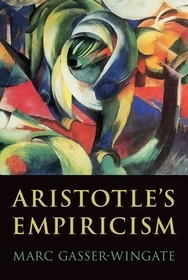
Aristotle's Empiricism
- Publisher's listprice GBP 78.00
-
35 217 Ft (33 540 Ft + 5% VAT)
The price is estimated because at the time of ordering we do not know what conversion rates will apply to HUF / product currency when the book arrives. In case HUF is weaker, the price increases slightly, in case HUF is stronger, the price goes lower slightly.
- Discount 10% (cc. 3 522 Ft off)
- Discounted price 31 695 Ft (30 186 Ft + 5% VAT)
Subcribe now and take benefit of a favourable price.
Subscribe
35 217 Ft

Availability
Estimated delivery time: In stock at the publisher, but not at Prospero's office. Delivery time approx. 3-5 weeks.
Not in stock at Prospero.
Why don't you give exact delivery time?
Delivery time is estimated on our previous experiences. We give estimations only, because we order from outside Hungary, and the delivery time mainly depends on how quickly the publisher supplies the book. Faster or slower deliveries both happen, but we do our best to supply as quickly as possible.
Product details:
- Publisher OUP USA
- Date of Publication 24 September 2021
- ISBN 9780197567456
- Binding Hardback
- No. of pages272 pages
- Size 147x213x25 mm
- Weight 431 g
- Language English 163
Categories
Short description:
Though Aristotle is often thought to be an empiricist-someone who thinks all knowledge is somehow derived from perception-the philosopher is often thought to have little to say on these matters. Gasser-Wingate here offers a sustained examination of these discussions and their epistemological, psychological, and ethical implications. It defends an interpretation of Aristotle as a moderate sort of empiricist, who thinks we can develop sophisticated forms of knowledge by broadly perceptual means, and that we therefore share an important part of our cognitive lives with nonrational animals, but also holds that our intellectual powers allow us to surpass them in certain ways, and develop distinctively human forms of understanding.
MoreLong description:
Aristotle is famous for thinking that all our knowledge comes from perception. But it's not immediately clear what this view is meant to entail. It's not clear, for instance, what perception is supposed to contribute to the more advanced forms of knowledge that derive from it. Nor is it clear how we should understand the nature of its contribution—what it might mean to say that these more advanced forms of knowledge are "derived from" or "based on" what we perceive.
Aristotle is often thought to have disappointingly little to say on these matters. Gasser-Wingate makes the case that this thought is mistaken: a coherent and philosophically attractive view of perceptual knowledge can be found in the various texts in which Aristotle discusses perception's role in animal life, the cognitive resources on which it does and does not depend, and the relation it bears to practical and theoretical modes of understanding.
Aristotle's Empiricism offers a sustained examination of these discussions and their epistemological, psychological, and ethical implications. It defends an interpretation of Aristotle as a moderate sort of empiricist, who thinks we can develop sophisticated forms of knowledge by broadly perceptual means—and that we therefore share an important part of our cognitive lives with nonrational animals—but also holds that our intellectual powers allow us to surpass these animals in certain ways and thereby develop distinctively human forms of understanding.
The book is a guide to Aristotle, but one that differs from more conventional, "rationalist" guides since its starting point is different. And it is not only the author's perspective which differs radically from the prevailing view, but maybe also the motivation behind his writing: by proposing a new reading of Aristotle, he is also restoring some unfortunately forgotten Ancient interpretations and problems.
Table of Contents:
1 Perception, Knowledge, and Understanding in Aristotle's Epistemology
2 Plato and Aristotle on Our Perceptual Beginnings
3 Understanding by Induction
4 Perception and Perceptual Contents
5 Perception, Experience, and Locomotion: Aristotle on Nonrational Learning
6 Perception in Aristotle's Ethics
7 Final Thoughts

