

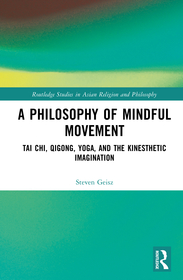
A Philosophy of Mindful Movement
Tai Chi, Qigong, Yoga, and the Kinesthetic Imagination
Sorozatcím: Routledge Studies in Asian Religion and Philosophy;
-
10% KEDVEZMÉNY?
- Kiadói listaár GBP 155.00
-
69 982 Ft (66 650 Ft + 5% áfa)
Az ár azért becsült, mert a rendelés pillanatában nem lehet pontosan tudni, hogy a beérkezéskor milyen lesz a forint árfolyama az adott termék eredeti devizájához képest. Ha a forint romlana, kissé többet, ha javulna, kissé kevesebbet kell majd fizetnie.
- Kedvezmény(ek) 10% (cc. 6 998 Ft off)
- Kedvezményes ár 62 984 Ft (59 985 Ft + 5% áfa)
62 984 Ft

Beszerezhetőség
Még nem jelent meg, de rendelhető. A megjelenéstől számított néhány héten belül megérkezik.
Why don't you give exact delivery time?
A beszerzés időigényét az eddigi tapasztalatokra alapozva adjuk meg. Azért becsült, mert a terméket külföldről hozzuk be, így a kiadó kiszolgálásának pillanatnyi gyorsaságától is függ. A megadottnál gyorsabb és lassabb szállítás is elképzelhető, de mindent megteszünk, hogy Ön a lehető leghamarabb jusson hozzá a termékhez.
A termék adatai:
- Kiadás sorszáma 1
- Kiadó Routledge
- Megjelenés dátuma 2026. május 27.
- ISBN 9781032778037
- Kötéstípus Keménykötés
- Terjedelem194 oldal
- Méret 234x156 mm
- Nyelv angol 700
Kategóriák
Rövid leírás:
This novel volume examines Chinese and Indian mindful movements (such as tai chi, qigong, Daoist meditation, and hatha yoga) to demonstrate how the contemplative practices of the body and mind can amount to a form of transformative philosophy through ways of thinking, knowing, and doing.
Több
Hosszú leírás:
This novel volume examines Chinese and Indian mindful movements (such as tai chi, qigong, Daoist meditation, and hatha yoga) to demonstrate how the contemplative practices of the body and mind can amount to a form of transformative philosophy through ways of thinking, knowing, and doing.
The book explains how these body practices use kinesthetic imagination, repetition, and slowness to bring about cognitive and epistemic changes in how we experience ourselves and the world. The chapters look in-depth at the details of these practices, drawing analogies with everyday experiences such as singing, hearing musical earworms, reading and re-reading texts, and recalling folk wisdom; the book suggests these body practices can be cognitive, epistemic, and philosophically transformative. The chapters also explore these practices in a first-person, biographical style, drawing on the author’s own experiences as a student and teacher of these practices. The descriptions take on a range of modes, from that of an insider to that of a skeptic, to those that are instructional in nature, and then to those that are more phenomenological. These various, sometimes-conflicting, descriptions raise meta-level questions about how best to understand the practices.
Focused on the study of embodied contemplative practice, this book will be of interest to scholars and postgraduates in the fields of Asian philosophy, Chinese philosophy, and the philosophy of religion more widely. Philosophers studying embodiment, embodied cognition, and religion will also find the volume of useful. Practitioners of martial arts, qigong, yoga, and meditation may benefit from the book.
TöbbTartalomjegyzék:
Introduction
1. Mindful Movement and the Promise of Transformation
2. What Are Mindful Movements?
3. Philosophy, in Words and Through the Body
4. Kinesthetic Earworms and Mindful Movements
5. Kinesthetic Fables and the Transient Diaphanes of Experience
6. Internal Martial Arts as Slow Looking
7. Repeat, Forget, Remember: Satiation, Familiarization, and Seed Movements
8. Symbols, Seeing-as, and Patterns Made of Qi
9. Teachers Everywhere: At the Edge of Observation and Make-Believe
Több
