

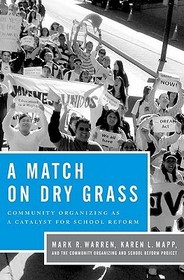
A Match on Dry Grass
Community Organizing as a Catalyst for School Reform
-
15% KEDVEZMÉNY?
- A kedvezmény csak az 'Értesítés a kedvenc témákról' hírlevelünk címzettjeinek rendeléseire érvényes.
- Kiadói listaár GBP 36.99
-
16 700 Ft (15 905 Ft + 5% áfa)
Az ár azért becsült, mert a rendelés pillanatában nem lehet pontosan tudni, hogy a beérkezéskor milyen lesz a forint árfolyama az adott termék eredeti devizájához képest. Ha a forint romlana, kissé többet, ha javulna, kissé kevesebbet kell majd fizetnie.
- Kedvezmény(ek) 15% (cc. 0 Ft off)
- Kedvezményes ár 14 195 Ft (13 519 Ft + 5% áfa)
- A kedvezmény érvényes eddig: 2026. augusztus 5.
Iratkozzon fel most és részesüljön kedvezőbb árainkból!
Feliratkozom
16 700 Ft

Beszerezhetőség
Megrendelésre a kiadó utánnyomja a könyvet. Rendelhető, de a szokásosnál kicsit lassabban érkezik meg.
Why don't you give exact delivery time?
A beszerzés időigényét az eddigi tapasztalatokra alapozva adjuk meg. Azért becsült, mert a terméket külföldről hozzuk be, így a kiadó kiszolgálásának pillanatnyi gyorsaságától is függ. A megadottnál gyorsabb és lassabb szállítás is elképzelhető, de mindent megteszünk, hogy Ön a lehető leghamarabb jusson hozzá a termékhez.
A termék adatai:
- Kiadó OUP USA
- Megjelenés dátuma 2011. szeptember 29.
- ISBN 9780199793587
- Kötéstípus Puhakötés
- Terjedelem328 oldal
- Méret 231x152x25 mm
- Súly 476 g
- Nyelv angol
- Illusztrációk 18 b/w halftones, 3 b/w line 0
Kategóriák
Rövid leírás:
A Match on Dry Grass argues that community organizing represents a fresh approach to address educational failure.
TöbbHosszú leírás:
The persistent failure of public schools in low-income neighborhoods, where fully half of black and Latino students fail to graduate with their peers, has vexed educators for decades. A Match on Dry Grass argues that community organizing represents a fresh and promising antidote to educational failure. Based on a comprehensive national study, the book presents rich and compelling case studies of prominent efforts in Chicago, New York City, Los Angeles, Denver, San Jose, and the Mississippi Delta. The authors show how organizing groups work to build the participation and leadership of parents and students so they can hold school systems accountable for real improvements. But organizing groups do not just demand change. They also collaborate with educators and other community residents to contribute to efforts to improve schooling. Out of these six case studies, Warren, Mapp, and their collaborators identify the central processes common to dynamic organizing efforts for school reform, outlining how community organizing builds the kinds of relationships that can transform schools and communities.
Civil rights activists in the 1960s insisted in the face of terror and death that national citizenship granted in the 14th Amendment meant something. That seminal work inspired organizing groups, active agents in an historic and on-going process, to bond with and bridge across racial, faith, gender, immigrant, and youth communities to reshape the narrative about the promise of citizenship. A Match on Dry Grass draws on these organizing traditions in the work to right 'the wrong this day done' in the nation's public schools. All of us doing that work will benefit from reading this book.
Tartalomjegyzék:
Preface & Acknowledgements
Introduction: A New Movement for Equity and Justice in Education
Chapter 1. How Community Organizing Works
Chapter 2. "A Match on Dry Grass"
Organizing for Great Schools in San Jose
Chapter 3. "An Appetite for Change"
Building Relational Cultures for Educational Reform and Civic Engagement in Los Angeles
Chapter 4. "Our Strength is the Power of Our Community "
Political Education and the Continuation of the Struggle in Denver
Chapter 5. "Weaving a Tapestry that won't Unravel "
The Transformation of Education in the Mississippi Delta
Chapter 6. "Acts of Leadership "
Building Powerful Forms of Parent Participation in Chicago
Chapter 7. "Cement between the Bricks "
Building Schools and Communities in New York City
Chapter 8. Building Relationships and Power to Transform Communities
and Schools
Conclusion: Lessons for School Reform and Democracy-Building
Appendix A Collaborative Research Process
References

