

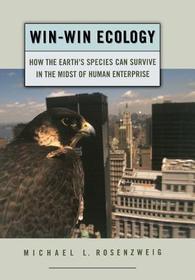
Win-Win Ecology
How the Earth's Species Can Survive in the Midst of Human Enterprise
- Publisher's listprice GBP 26.49
-
11 960 Ft (11 390 Ft + 5% VAT)
The price is estimated because at the time of ordering we do not know what conversion rates will apply to HUF / product currency when the book arrives. In case HUF is weaker, the price increases slightly, in case HUF is stronger, the price goes lower slightly.
- Discount 10% (cc. 1 196 Ft off)
- Discounted price 10 764 Ft (10 251 Ft + 5% VAT)
Subcribe now and take benefit of a favourable price.
Subscribe
11 960 Ft

Availability
printed on demand
Why don't you give exact delivery time?
Delivery time is estimated on our previous experiences. We give estimations only, because we order from outside Hungary, and the delivery time mainly depends on how quickly the publisher supplies the book. Faster or slower deliveries both happen, but we do our best to supply as quickly as possible.
Product details:
- Publisher OUP Oxford
- Date of Publication 15 May 2003
- ISBN 9780195156041
- Binding Hardback
- No. of pages224 pages
- Size 245x160x22 mm
- Weight 485 g
- Language English
- Illustrations numerous halftones and line drawings 0
Categories
Short description:
In this book, an eminent ecologist proposes a new more conciliatory or realistic approach to protecting the environment and biodiversity, which he calls reconciliation ecology. This message may resonate well with the environmental movement and beyond, because it gives readers guidelines to achieve practical, useful improvements in our environment, without the elitist attitudes that many environmentalists have seemed to hold about the pressures of local peoples to make use of their environments for their own economic well-being. This book seeks common ground between responsible forces for development, and conservationists, and gives a number of inspiring and empowering examples of what good ends can and have been achieved.
MoreLong description:
As humanity presses down inexorably on the natural world, people debate the extent to which we can save the Earth's millions of different species without sacrificing human economic welfare. But is this argument wise? Must the human and natural worlds be adversaries?
In this book, ecologist Michael Rosenzweig finds that ecological science actually rejects such polarization. Instead it suggests that, to be successful, conservation must discover how we can blend a rich natural world into the world of economic activity. This revolutionary, common ground between development and conservation is called reconciliation ecology: creating and maintaining species-friendly habitats in the very places where people live, work, or play.
The book offers many inspiring examples of the good results already achieved. The Nature Conservancy, for instance, has a cooperative agreement with the Department of Defense, with more than 200 conservation projects taking place on more than 170 bases in 41 states. In places such as Elgin Air Force Base, the human uses-testing munitions, profitable timbering and recreation--continue, but populations of several threatened species on the base, such as the long-leaf pine and the red-cockaded woodpecker, have been greatly improved. The Safe Harbor strategy of the Fish & Wildlife Service encourages private landowners to improve their property for endangered species, thus overcoming the unintended negative aspects of the Endangered Species Act. And Golden Gate Park, which began as a system of sand dunes, has become, through human effort, a world of ponds and shrubs, waterfowl and trees.
Rosenzweig shows that reconciliation ecology is the missing tool of conservation, the practical, scientifically based approach that, when added to the rest, will solve the problem of preserving Earth's species.
This book seeks common ground between responsible forces for development, and conservationists, and gives a number of inspiring and empowering examples of what good ends can and have been achieved.

