

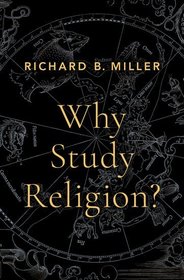
Why Study Religion?
- Publisher's listprice GBP 38.99
-
17 603 Ft (16 765 Ft + 5% VAT)
The price is estimated because at the time of ordering we do not know what conversion rates will apply to HUF / product currency when the book arrives. In case HUF is weaker, the price increases slightly, in case HUF is stronger, the price goes lower slightly.
- Discount 20% (cc. 3 521 Ft off)
- Discounted price 14 083 Ft (13 412 Ft + 5% VAT)
- Discount is valid until: 30 June 2026
Subcribe now and take benefit of a favourable price.
Subscribe
17 603 Ft

Availability
Estimated delivery time: In stock at the publisher, but not at Prospero's office. Delivery time approx. 3-5 weeks.
Not in stock at Prospero.
Why don't you give exact delivery time?
Delivery time is estimated on our previous experiences. We give estimations only, because we order from outside Hungary, and the delivery time mainly depends on how quickly the publisher supplies the book. Faster or slower deliveries both happen, but we do our best to supply as quickly as possible.
Product details:
- Publisher OUP USA
- Date of Publication 12 January 2023
- ISBN 9780197566817
- Binding Hardback
- No. of pages384 pages
- Size 166x242x32 mm
- Weight 644 g
- Language English 270
Categories
Short description:
Why Study Religion? offers an alternative framework, Critical Humanism, for thinking about the purposes of the discipline. Richard B. Miller theorizes about the ends rather than the means of humanistic scholarship. He argues that the future of religious studies will depend on how well it can articulate its goals as a basis for motivating scholarship in the field.
MoreLong description:
Can the study of religion be justified? Scholarship in religion, especially work in "theory and method," is preoccupied with matters of research procedure and thus inarticulate about the goals that motivate scholarship in the field. For that reason, the field suffers from a crisis of rationale. Richard B. Miller identifies six prevailing methodologies in the field, and then offers an alternative framework for thinking about the purposes of the discipline. Shadowing these various methodologies, he notes, is a Weberian scientific ideal for studying religion, one that aspires to value-neutrality. This ideal fortifies a "regime of truth" that undercuts efforts to think normatively and teleologically about the field's purpose and value. Miller's alternative framework, Critical Humanism, theorizes about the ends rather than the means of humanistic scholarship.
Why Study Religion? offers an account of humanistic inquiry that is held together by four values: Post-critical Reasoning, Social Criticism, Cross-cultural Fluency, and Environmental Responsibility. Ordered to such purposes, Miller argues, scholars of religion can relax their commitment to matters of methodological procedure and advocate for the value of studying religion. The future of religious studies will depend on how well it can articulate its goals as a basis for motivating scholarship in the field.
This brilliant book is both a powerful criticism of the current state of religious studies and an impassioned plea for an entirely new approach.... Essential.
Table of Contents:
Acknowledgments
I. A Crisis of Rationale
Chapter 1: On Justifying the Study of Religion
Chapter 2: The Ethics of Religious Studies
II. A Regime of Truth
Chapter 3: Interpretation, Comparison, and the History of Religions
Chapter 4: Scientific Rationality and Causal Explanation
Chapter 5: Existential Symbolism and Theological Anthropology
Chapter 6: Embodied Practice and Materialistic Phenomenology
Chapter 7: Genealogy, Ideology, and Critical Theory
Chapter 8: Philosophy, Normativity, and Metacriticism
III. Purposes, Desires, and Critical Humanism
Chapter 9: Religious Studies and the Values of Critical Humanism
1. The End of Religious Studies
2. Acts and Moral Agency
3. Critical Humanism
4. Four Values
5. Exemplary Works in the Study of Religion
6. Critical Humanism and the Ethics of Religious Studies
Epilogue: Critical Humanism as a Vocation

