

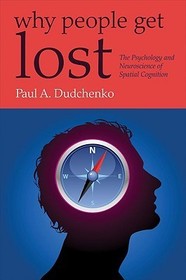
Why People Get Lost
The Psychology and Neuroscience of Spatial Cognition
- Publisher's listprice GBP 75.00
-
40 957 Ft (32 250 Ft + 27% VAT)
The price is estimated because at the time of ordering we do not know what conversion rates will apply to HUF / product currency when the book arrives. In case HUF is weaker, the price increases slightly, in case HUF is stronger, the price goes lower slightly.
- Discount 10% (cc. 4 096 Ft off)
- Discounted price 36 862 Ft (29 025 Ft + 27% VAT)
Subcribe now and take benefit of a favourable price.
Subscribe
40 957 Ft

Availability
printed on demand
Why don't you give exact delivery time?
Delivery time is estimated on our previous experiences. We give estimations only, because we order from outside Hungary, and the delivery time mainly depends on how quickly the publisher supplies the book. Faster or slower deliveries both happen, but we do our best to supply as quickly as possible.
Product details:
- Publisher OUP Oxford
- Date of Publication 1 July 2010
- ISBN 9780199210862
- Binding Map
- No. of pages314 pages
- Size 241x163x24 mm
- Weight 648 g
- Language English 0
Categories
Short description:
At some point in our lives, most of us have been lost. How does this happen? What are the limits of our ability to find our way? Do we have an innate sense of direction? 'How people get lost' is a exciting exploration of the psychology and neuroscience of how we find our way.
MoreLong description:
At some point in our lives, most of us have been lost. How does this happen? What are the limits of our ability to find our way? Do we have an innate sense of direction?
'How people get lost' reviews the psychology and neuroscience of navigation. It starts with a history of studies looking at how organisms solve mazes. It then reviews contemporary studies of spatial cognition, and the wayfinding abilities of adults and children. It then considers how specific parts of the brain provide a cognitive map and a neural compass. This book also considers the neurology of spatial disorientation, and the tendency of patients with Alzheimer's disease to lose their way.
Within the book, the author proposes that we get lost because our brain's compass becomes misoriented.
This book is written for anyone with an interest in navigation and the brain. It assumes no specialised knowledge of neuroscience, but covers recent advances in our understanding of how the brain represents space.
Table of Contents:
Preface
Acknowledgements
Dedication
On being lost
A history of "maze" psychology
Contemporary studies of spatial cognition
Human navigation
Spatial cognition in children
The hippocampus as a cognitive map
Place cells and brain imaging
The neural basis for a sense of direction: head direction neurons
Alzheimer's disease, the parietal lobe, and topographical disorientation
Why we get lost

