

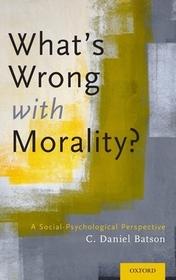
What's Wrong With Morality?
A Social-Psychological Perspective
- Publisher's listprice GBP 130.00
-
58 695 Ft (55 900 Ft + 5% VAT)
The price is estimated because at the time of ordering we do not know what conversion rates will apply to HUF / product currency when the book arrives. In case HUF is weaker, the price increases slightly, in case HUF is stronger, the price goes lower slightly.
- Discount 10% (cc. 5 870 Ft off)
- Discounted price 52 826 Ft (50 310 Ft + 5% VAT)
Subcribe now and take benefit of a favourable price.
Subscribe
58 695 Ft

Availability
printed on demand
Why don't you give exact delivery time?
Delivery time is estimated on our previous experiences. We give estimations only, because we order from outside Hungary, and the delivery time mainly depends on how quickly the publisher supplies the book. Faster or slower deliveries both happen, but we do our best to supply as quickly as possible.
Product details:
- Publisher OUP USA
- Date of Publication 17 December 2015
- ISBN 9780199355549
- Binding Hardback
- No. of pages272 pages
- Size 163x236x25 mm
- Weight 490 g
- Language English 0
Categories
Short description:
What's Wrong with Morality? considers morality not only as a solution but also as a problem. It focuses on moral action, not simply moral judgment. To account for our moral failures, it considers the range of motives and emotion (many of which are not intrinsically moral) that can lead us to act ethically--or not.
MoreLong description:
Most works on moral psychology direct our attention to the positive role morality plays for us as individuals, as a society, even as a species. In What's Wrong with Morality?, C. Daniel Batson takes a different approach: he looks at morality as a problem. The problem is not that it is wrong to be moral, but that our morality often fails to produce these intended results. Why? Some experts believe the answer lies in lack of character. Others say we are victims of poor judgment. If we could but discern what is morally right, whether through logical analysis and discourse, through tuned intuition and a keen moral sense, or through feeling and sentiment, we would act accordingly. Implicit in these different views is the assumption that if we grow up properly, if we can think and feel as we should, and if we can keep a firm hand on the tiller through the storms of circumstance, all will be well. We can realize our moral potential.
Many of our best writers of fiction are less optimistic. Astute observers of the human condition like Austen, Balzac, Dickens, Dostoyevsky, Eliot, Tolstoy, and Twain suggest our moral psychology is more complex. These writers encourage us to look more closely at our motives, emotions, and values, at what we really care about in the moral domain. In this volume, Batson examines this issue from a social-psychological perspective. Drawing on research suggesting our moral life is fertile ground for rationalization and deception, including self-deception, Batson offers a hard-nosed analysis of morality and its limitations in this expertly written book.
Batson's starting point is the observation that moral life suffers from maladies: very often, we fail to live up to our own moral standards. ... According to Batosn, the real role of interpersonal morality is not to control our own behaviour, but that of others: "[...] we want to be treated morally, not to be moral oursevles" (177). ... When Batson looks for ways to strengthen moral behaviour at the end of his book, he does not really believe that true moral motivation can be substanially strengthed.
Table of Contents:
Introduction
Part I: What's Wrong
Chapter 1: Moral Maladies
Chapter 2: Personal Deficiency
Chapter 3: Situational Pressure
Part II: What's More
Chapter 4: Moral Motivation
Chapter 5: Why Is Moral Integrity Rare, Hypocrisy Common?
Chapter 6: Moral Emotion
Part III: So What
Chapter 7: Moral Combat
Chapter 8: Treating Our Moral Maladies
Reprise
References

