

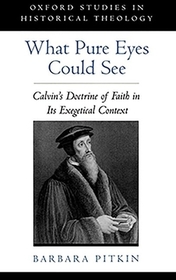
What Pure Eyes Could See
Calvin's Doctrine of Faith in its Exegetical Context
Series: Oxford Studies in Historical Theology;
- Publisher's listprice GBP 165.00
-
74 497 Ft (70 950 Ft + 5% VAT)
The price is estimated because at the time of ordering we do not know what conversion rates will apply to HUF / product currency when the book arrives. In case HUF is weaker, the price increases slightly, in case HUF is stronger, the price goes lower slightly.
- Discount 10% (cc. 7 450 Ft off)
- Discounted price 67 048 Ft (63 855 Ft + 5% VAT)
Subcribe now and take benefit of a favourable price.
Subscribe
74 497 Ft

Availability
printed on demand
Why don't you give exact delivery time?
Delivery time is estimated on our previous experiences. We give estimations only, because we order from outside Hungary, and the delivery time mainly depends on how quickly the publisher supplies the book. Faster or slower deliveries both happen, but we do our best to supply as quickly as possible.
Product details:
- Publisher OUP USA
- Date of Publication 2 December 1999
- ISBN 9780195128284
- Binding Hardback
- No. of pages272 pages
- Size 167x232x24 mm
- Weight 531 g
- Language English 0
Categories
Short description:
Barbara Pitkin traces the way in which Calvin's exegetical labours contributed to his understanding of faith. Through detailed analysis of Calvin's interpretation of selected biblical passages, this study shows how his views evolved. Pitkin describes the gradual development of the mature Calvin's view that faith exhibits a twofold character -- saving faith and providential faith -- that corresponds to the twofold aspect its object -- Christ as both the incarnate and eternal Son of God.
MoreLong description:
Barbara Pitkin traces the way in which Calvin's exegetical labours contributed to his understanding of faith. Through detailed analysis of Calvin's interpretation of selected biblical passages, this study shows how his views evolved. Pitkin describes the gradual development of the mature Calvin's view that faith exhibits a twofold character -- saving faith and providential faith -- that corresponds to the twofold aspect its object -- Christ as both the incarnate and eternal Son of God.
Pitkin's exegesis of Calvin is careful and technical. It will be a welcome addition to the library of Calvin and Reformation scholars specifically, and to all theologians more generally.

