

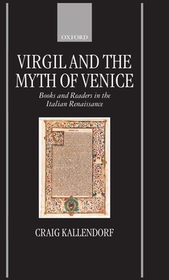
Virgil and the Myth of Venice
Books and Readers in the Italian Renaissance
- Publisher's listprice GBP 180.00
-
81 270 Ft (77 400 Ft + 5% VAT)
The price is estimated because at the time of ordering we do not know what conversion rates will apply to HUF / product currency when the book arrives. In case HUF is weaker, the price increases slightly, in case HUF is stronger, the price goes lower slightly.
- Discount 10% (cc. 8 127 Ft off)
- Discounted price 73 143 Ft (69 660 Ft + 5% VAT)
Subcribe now and take benefit of a favourable price.
Subscribe
81 270 Ft

Availability
printed on demand
Why don't you give exact delivery time?
Delivery time is estimated on our previous experiences. We give estimations only, because we order from outside Hungary, and the delivery time mainly depends on how quickly the publisher supplies the book. Faster or slower deliveries both happen, but we do our best to supply as quickly as possible.
Product details:
- Publisher OUP Oxford
- Date of Publication 1 July 1999
- ISBN 9780198152545
- Binding Hardback
- No. of pages260 pages
- Size 223x145x18 mm
- Weight 412 g
- Language English
- Illustrations 11 halftones 0
Categories
Short description:
Virgil and the Myth of Venice focuses on one traditionally esteemed author, the Roman poet Virgil, and reconstructs how his poetry was understood by one especially important group of readers, those in Renaissance Venice. For these readers, Virgil's poetry became a best-seller because it sometimes challenged, but more often confirmed, the specific moral, religious, and social values they brought with them to their books.
MoreLong description:
This book, which is the first comprehensive study of its subject, shows how one traditionally esteemed author, the Roman poet Virgil, played an unexpectedly significant role in the shaping of Venetian Renaissance culture. The author draws on reception theory, the sociology of literature, and history of the book to argue that Virgil's poetry became a best-seller because it sometimes challenged, but more often confirmed, the specific moral, religious, and social values its Venetian readers brought with them to their texts. The texts that are used are the printed books of the fifteenth and sixteenth century printed books in which readers of the period encountered Virgil, the prefaces and commentaries that guided their responses, and, the marginal notes that record those responses. How the Renaissance Venetians saw themselves when they looked into their literary past tells us a good deal about them, but it also illuminates a number of issues at the centre of humanistic studies today, ranging from how reading takes place to the role of class and gender in fashioning interpretation.
The wide range of interests that are touched on should make this book of value to scholars in the disciplines of classics, history, Renaissance studies, and Italian studies, as well as English literature and cultural studies.
Ample footnotes confirm a range and depth of reading that are evident from an agreeable written text of unusual learning, alertness and circumspection

