

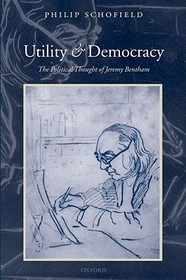
Utility and Democracy
The Political Thought of Jeremy Bentham
Series: Pasold Studies in Textile History;
- Publisher's listprice GBP 102.50
-
46 278 Ft (44 075 Ft + 5% VAT)
The price is estimated because at the time of ordering we do not know what conversion rates will apply to HUF / product currency when the book arrives. In case HUF is weaker, the price increases slightly, in case HUF is stronger, the price goes lower slightly.
- Discount 10% (cc. 4 627 Ft off)
- Discounted price 41 651 Ft (39 668 Ft + 5% VAT)
Subcribe now and take benefit of a favourable price.
Subscribe
46 278 Ft

Availability
printed on demand
Why don't you give exact delivery time?
Delivery time is estimated on our previous experiences. We give estimations only, because we order from outside Hungary, and the delivery time mainly depends on how quickly the publisher supplies the book. Faster or slower deliveries both happen, but we do our best to supply as quickly as possible.
Product details:
- Publisher OUP Oxford
- Date of Publication 29 June 2006
- ISBN 9780198208563
- Binding Hardback
- No. of pages384 pages
- Size 242x163x27 mm
- Weight 744 g
- Language English 0
Categories
Short description:
In this first full historical account of the political thought of Jeremy Bentham (1748-1832), Philip Schofield shows how Bentham's insights in the fields of logic and language led to the first defence of democracy from a utilitarian perspective, and to the creation of the philosophic radicals, dedicated to political, legal, ecclesiastical, and social reform.
MoreLong description:
This book is the first comprehensive historical account of the political thought of Jeremy Bentham (1748-1832), the philosopher and reformer. Professor Schofield draws on his extensive knowledge of Bentham's unpublished manuscripts and original printed texts, and on the new, authoritative edition of The Collected Works of Jeremy Bentham. A compelling narrative charts the way in which Bentham applied his utilitarian philosophy to the rapidly changing circumstances of his age.
Professor Schofield begins with a lucid account of Bentham's insights in the fields of logic and language, and in particular his theory of real and fictitious entities, which lie at the foundation of his thought. Professor Schofield proceeds to show how these insights brought Bentham to the principle of utility, which led him in turn to produce the first systematic defence of democracy from a utilitarian perspective. In contrast to previous scholarship, which claims that Bentham's 'conversion' or 'transition' to political radicalism took place either at the time of the French Revolution or following his meeting with James Mill in 1808 or 1809, Professor Schofield shows that the process began in or around 1804 when the notion of sinister interest emerged in Bentham's thought. Bentham appreciated that rulers, rather than being motivated by a desire to promote the greatest happiness of those subject to them, aimed to promote their own happiness, whatever the overall cost to the community.
In his constitutional writings of the 1820s, which he addressed to 'all nations professing liberal opinions', Bentham argued that the proper end of constitutional design was to maximize official aptitude and minimize government expense, and that the publicity of official actions, within the context of a republican system of government where sovereignty lay in the people, was the means to achieve it. Bentham's commitment to radical reform led him to advocate the abolition of the British monarchy and House of Lords, the replacement of the Common Law with a codified system of law, and the 'euthanasia' of the Anglican Church.
...anyone who wants to understand Bentham's evolution into radical democrat must now start with this thorough study.
Table of Contents:
Real and Fictitious Entities
The Principle of Utility
Natural Law and Natural Rights
The French Revolution
The Emergence of Sinister Interest
Parliamentary Reform
The Church
Colonies and Constitutional Law
Codification, Constitutional Law, and Republicanism
Publicity, Responsibility, and the Architecture of Government
The Antidote to Sinister Interest: Official Aptitude
The Politics of Law Reform
Last Things
Bibliography
Index

