

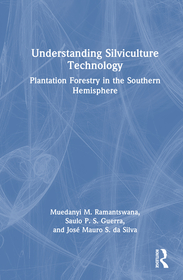
Understanding Silviculture Technology
Plantation Forestry in the Southern Hemisphere
- Publisher's listprice GBP 155.00
-
69 982 Ft (66 650 Ft + 5% VAT)
The price is estimated because at the time of ordering we do not know what conversion rates will apply to HUF / product currency when the book arrives. In case HUF is weaker, the price increases slightly, in case HUF is stronger, the price goes lower slightly.
- Discount 20% (cc. 13 996 Ft off)
- Discounted price 55 986 Ft (53 320 Ft + 5% VAT)
- Discount is valid until: 30 June 2026
Subcribe now and take benefit of a favourable price.
Subscribe
62 984 Ft

Availability
Estimated delivery time: In stock at the publisher, but not at Prospero's office. Delivery time approx. 3-5 weeks.
Not in stock at Prospero.
Why don't you give exact delivery time?
Delivery time is estimated on our previous experiences. We give estimations only, because we order from outside Hungary, and the delivery time mainly depends on how quickly the publisher supplies the book. Faster or slower deliveries both happen, but we do our best to supply as quickly as possible.
Product details:
- Edition number 1
- Publisher Routledge
- Date of Publication 16 March 2026
- ISBN 9781032488806
- Binding Hardback
- No. of pages208 pages
- Size 234x156 mm
- Weight 540 g
- Language English
- Illustrations 57 Illustrations, black & white; 57 Line drawings, black & white; 11 Tables, black & white 687
Categories
Short description:
This book describes the various technologies used in silviculture with a special focus on newer technologies which have been adopted over the past two decades in plantation forestry practiced in the Southern Hemisphere. It will be of use to students of silviculture and forestry, as well as professionals working in the forestry industry.
MoreLong description:
This book describes the various technologies used in silviculture with a special focus on newer technologies that have been adopted over the past two decades in plantation forestry practised in the Southern Hemisphere.
Historically, innovations in silviculture technology have been slow to develop; however, over the past two decades, new technologies have been invented and adopted to deal with labour, efficiency, and quality challenges. This book presents a comprehensive introduction to modern silviculture technology, as well as explains the environment and operations within which these technologies are used. In the context of this book, the focus is on industrial plantation forests grown in a range of Southern Hemisphere countries, mainly South Africa and Brazil, with a specific focus on the technologies used in establishing and tending eucalypts, pine, and wattle species. This book examines modern technologies used to produce trees from a nursery, including managing residues on the site, preparing the soil, fertilising, and irrigating the plants. It then examines the technologies available for after planting, including those that can assist in eliminating weeds, pruning, thinning, and fire protection systems. This book also discusses digital technologies available to manage silvicultural operations. By the end of this book, readers will have a strong understanding of the range of technologies available, the impact of those technologies, and their capabilities and limitations.
This book will be of great use to students of silviculture and forestry, as well as professionals working in the forestry industry.
MoreTable of Contents:
1. Introduction 2. Nursery Technologies 3. Silviculture Technologies in the Establishment and Re‑establishment of Forests 4. Silviculture Technologies in Stand Tending 5. Key Technological Innovations in Silviculture 6. Relationship between Silviculture and Harvesting 7. Conclusion
More
