

- Publisher's listprice GBP 9.99
-
4 510 Ft (4 295 Ft + 5% VAT)
The price is estimated because at the time of ordering we do not know what conversion rates will apply to HUF / product currency when the book arrives. In case HUF is weaker, the price increases slightly, in case HUF is stronger, the price goes lower slightly.
- Discount 10% (cc. 451 Ft off)
- Discounted price 4 059 Ft (3 866 Ft + 5% VAT)
Subcribe now and take benefit of a favourable price.
Subscribe
4 510 Ft

Availability
Estimated delivery time: In stock at the publisher, but not at Prospero's office. Delivery time approx. 3-5 weeks.
Not in stock at Prospero.
Why don't you give exact delivery time?
Delivery time is estimated on our previous experiences. We give estimations only, because we order from outside Hungary, and the delivery time mainly depends on how quickly the publisher supplies the book. Faster or slower deliveries both happen, but we do our best to supply as quickly as possible.
Product details:
- Publisher OUP Oxford
- Date of Publication 22 November 2018
- ISBN 9780199211296
- Binding Paperback
- No. of pages176 pages
- Size 176x109x10 mm
- Weight 138 g
- Language English
- Illustrations 25 black and white images 0
Categories
Short description:
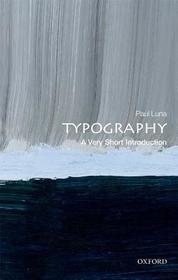
Typography encompasses design for reading, whether in print or on screens, where a set of visual choices to do with font, layout, and print size are taken to enhance a written message. Paul Luna explores the fascinating history of our letters, considering why typographic decisions are taken, and their impact on our own words.
MoreLong description:
Typography, the art of designing printed words, was once the domain of an elite few artists but has become an area with which millions of people engage daily. The widespread usage of digital devices from laptops to tablets and smart phones which are used for written communications means that we are regularly asked to make decisions about the fonts, sizes, and layouts we use in our writing. This broadening engagement with the field of typography has led to a perceptible shift from debates about legibility and technicalities to conversations about which fonts best reflect the writer's personality or style .
In this Very Short Introduction, Paul Luna offers a broad definition of typography as design for reading, whether in print or on screens, where a set of visual choices are taken to make a written message more accessible, more easily transmitted, more significant, or more attractive. Considering the development of letterforms and the shapes of letter we use, Luna discusses the history behind our modern day letters and fonts, before considering the issues behind key typographic decisions, and the differences between printed and on-screen typography. Presenting any piece of typography as a fundamental design choice, Luna introduces the options available today, and explores the reasons why key typographic decisions are made.
ABOUT THE SERIES: The Very Short Introductions series from Oxford University Press contains hundreds of titles in almost every subject area. These pocket-sized books are the perfect way to get ahead in a new subject quickly. Our expert authors combine facts, analysis, perspective, new ideas, and enthusiasm to make interesting and challenging topics highly readable.
"Enjoyable and accessible ... Luna is an ideal guide. A particularly fascinating section on the different ways in which readers read, informed by psychologists studies, should be of interest to all readers, as well as to anyone who hopes that their words will be read."
Table of Contents:
Preface
Acknowledgements
Perfect letters
Practical letters
Presenting language
Genre and layout
Persuasion, information, art
Picture language
Evidence for design decisions
Positive typography
Appendix 1: Dogma for designers
Appendix 2: Good practice in typesetting
Further reading
Index

