

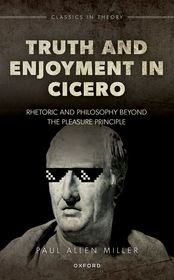
Truth and Enjoyment in Cicero
Rhetoric and Philosophy Beyond the Pleasure Principle
Series: Classics in Theory Series;
- Publisher's listprice GBP 104.00
-
49 686 Ft (47 320 Ft + 5% VAT)
The price is estimated because at the time of ordering we do not know what conversion rates will apply to HUF / product currency when the book arrives. In case HUF is weaker, the price increases slightly, in case HUF is stronger, the price goes lower slightly.
- Discount 10% (cc. 4 969 Ft off)
- Discounted price 44 717 Ft (42 588 Ft + 5% VAT)
Subcribe now and take benefit of a favourable price.
Subscribe
49 686 Ft

Availability
Not yet published.
Why don't you give exact delivery time?
Delivery time is estimated on our previous experiences. We give estimations only, because we order from outside Hungary, and the delivery time mainly depends on how quickly the publisher supplies the book. Faster or slower deliveries both happen, but we do our best to supply as quickly as possible.
Product details:
- Publisher OUP Oxford
- Date of Publication 16 April 2026
- ISBN 9780198931324
- Binding Hardback
- No. of pages320 pages
- Size 216x138 mm
- Language English 700
Categories
Short description:
Marcus Tullius Cicero was a practicing lawyer, politician, and philosopher in first century BCE Rome. He understood that living in the world requires a form of writing and thinking that acknowledges our embodied experience. This book offers a psychoanalytic treatment of Cicero and a re-examination of the relation between truth and enjoyment.
MoreLong description:
Truth and Enjoyment in Cicero offers a fundamental re-examination of the relation between truth and enjoyment as understood in the traditional confrontation between rhetoric and philosophy in Cicero. His simultaneous advocacy of classical rationality and continued emphasis on the importance of performativity and enjoyment in language-on ratio as a desire (cupiditas) and force (vis) in the real-situates him at the crossroads of reason and the unconscious. Where the modern concept of truth abstracts truth from the subjective experience of speaker and hearer, for Cicero truth is inseparable from our experience of it, and it is precisely the possibility of their separation that he criticizes in works like De Oratore and De Re Publica where he seeks an ideal reconciliation between rhetoric and philosophy, truth and enjoyment. This book looks at the problem of enjoyment (jouissance) as central to understanding the differend between rhetoric and philosophy. Paul Allen Miller distinguishes "pleasure" from "enjoyment," with pleasure always being balanced by the constraints of the reality principle and hence always open to substitution and deferral. Jouissance, however, is a drive that leads beyond any utilitarian calculus, seeking a form of radical experience that can be both sublime and destructive.
There has never been a psychoanalytic treatment of Cicero's philosophical works, and while we must beware of crude attempts to psychoanalyze a long-dead author, Freud's hermeneutic model can provide new insights into Cicero's investment in concepts of desire, the sublime, and the abject, as well as how these concepts undergird his understanding of rational appeals to his audience. The conflict between rhetoric and philosophy dates to at least the fifth century. It has often understood itself as a conflict between a discourse that speaks to desire and one that speaks to truth. In the Gorgias, the rhetor is compared to the pastry chef, while the philosopher is the doctor whose bitter gall leads to health. Cicero is situated at this nexus between these figures, and, as he has Crassus argue in De Oratore Book 3, we live a more destitute and impoverished existence since these functions of discourse, truth and desire, have been split apart.
Miller offers the first psychoanalytic account of Cicero as a philosopher and rhetorician, bringing a fresh reading of five Cicero's major works during a crucial period of the Roman republic.
Table of Contents:
Introduction: Why Cicero and Why Now: Truth and Enjoyment
Rhetoric and Philosophy in De Oratore: Healing the World
"Set Your Controls for the Heart of the Sun: De Re Publica and the Governmental Sublime"
De Amicitia: Love, Death, and a Friendship to Come
The Heart of Darkness: Truth and Enjoyment in the Philippics
Wish-Fulfillment in De Officiis: Cicero's Aesthetics of Existence
Introduction: Why Cicero and Why Now: Truth and Enjoyment
Rhetoric and Philosophy in De Oratore: Healing the World
"Set Your Controls for the Heart of the Sun: De Re Publica and the Governmental Sublime"
De Amicitia: Love, Death, and a Friendship to Come
The Heart of Darkness: Truth and Enjoyment in the Philippics
Wish-Fulfillment in De Officiis: Cicero's Aesthetics of Existence
Introduction: Why Cicero and Why Now: Truth and Enjoyment
Rhetoric and Philosophy in De Oratore: Healing the World
"Set Your Controls for the Heart of the Sun: De Re Publica and the Governmental Sublime"
De Amicitia: Love, Death, and a Friendship to Come
The Heart of Darkness: Truth and Enjoyment in the Philippics
Wish-Fulfillment in De Officiis: Cicero's Aesthetics of Existence
Introduction: Why Cicero and Why Now: Truth and Enjoyment
Rhetoric and Philosophy in De Oratore: Healing the World
"Set Your Controls for the Heart of the Sun: De Re Publica and the Governmental Sublime"
De Amicitia: Love, Death, and a Friendship to Come
The Heart of Darkness: Truth and Enjoyment in the Philippics
Wish-Fulfillment in De Officiis: Cicero's Aesthetics of Existence

