

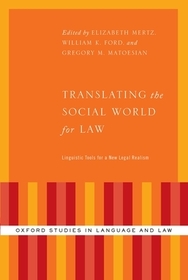
Translating the Social World for Law
Linguistic Tools for a New Legal Realism
Series: Oxford Studies in Language and Law;
- Publisher's listprice GBP 28.49
-
12 863 Ft (12 250 Ft + 5% VAT)
The price is estimated because at the time of ordering we do not know what conversion rates will apply to HUF / product currency when the book arrives. In case HUF is weaker, the price increases slightly, in case HUF is stronger, the price goes lower slightly.
- Discount 20% (cc. 2 573 Ft off)
- Discounted price 10 290 Ft (9 800 Ft + 5% VAT)
- Discount is valid until: 30 June 2026
Subcribe now and take benefit of a favourable price.
Subscribe
12 863 Ft

Availability
Estimated delivery time: In stock at the publisher, but not at Prospero's office. Delivery time approx. 3-5 weeks.
Not in stock at Prospero.
Why don't you give exact delivery time?
Delivery time is estimated on our previous experiences. We give estimations only, because we order from outside Hungary, and the delivery time mainly depends on how quickly the publisher supplies the book. Faster or slower deliveries both happen, but we do our best to supply as quickly as possible.
Product details:
- Publisher OUP USA
- Date of Publication 25 August 2020
- ISBN 9780197537367
- Binding Paperback
- No. of pages312 pages
- Size 231x155x20 mm
- Weight 522 g
- Language English 32
Categories
Short description:
In coordinated papers that are grounded in empirical research, the volume contributors use careful linguistic analysis to understand how attempts to translate between different disciplines can misfire in systematic ways. This problem takes on real-life significance when one of the fields is law, where how knowledge is conveyed can affect how justice is meted out.
MoreLong description:
This volume examines the linguistic problems that arise in efforts to translate between law and the social sciences. We usually think of "translation" as pertaining to situations involving distinct languages such as English and Swahili. But realistically, we also know that there are many kinds of English or Swahili, so that some form of translation may still be needed even between two people who both speak English-including, for example, between English speakers who are members of different professions. Law and the social sciences certainly qualify as disciplines with quite distinctive language patterns and practices, as well as different orientations and goals. In coordinated papers that are grounded in empirical research, the volume contributors use careful linguistic analysis to understand how attempts to translate between different disciplines can misfire in systematic ways. Some contributors also point the way toward more fruitful translation practices.
The contributors to this volume are members of an interdisciplinary working group on Legal Translation that met for a number of years. The group includes scholars from law, philosophy, anthropology, linguistics, political science, psychology, and religious studies. The members of this group approach interdisciplinary communication as a form of "translation" between distinct disciplinary languages (or, "registers"). Although it may seem obvious that professionals in different fields speak and think differently about the world, in fact experts in law and in social science too often assume that they can communicate easily when they are speaking what appears to be the "same" language. While such experts may intellectually understand that they differ regarding their fundamental assumptions and uses of language, they may nonetheless consistently underestimate the degree to which they are actually talking past one another. This problem takes on real-life significance when one of the fields is law, where how knowledge is conveyed can affect how justice is meted out.
Table of Contents:
1.Introduction: Translating Law and Social Science
William K. Ford & Elizabeth Mertz
PART ONE Analyzing Legal Translations on the Ground
2. Translating Defendants' Apologies During Allocution at Sentencing
M. Catherine Gruber
2A Gruber "In Translation"
Frances Tung
3. Translating Token Instances of "This" into Type Patterns of "That": The Discursive and
Multimodal Translation of Evidence into Precedent
Gregory Matoesian
3A Matoesian "In Translation"
Christopher Roy and Elizabeth Mertz
4. Comments on Matoesian and Gruber: Performative Risks in Risking Performance
Michael Silverstein
4A Silverstein "In Translation"
Elizabeth Mertz
PART TWO System-Level Challenges: When Courts Translate Social Science
5. The Law and Science of Video Game Violence: Who Lost More in Translation?
William K. Ford
6. Being Human: Negotiating Religion, Law, and Science in the Classroom and the Courtroom
Winnifred Fallers Sullivan
7. Social Science and the Ways of the Trial Court: Possibilities of Translation
Robert P. Burns
8. Part Two Commentary: Processes of Translation and Demarcation in Legal Worlds
Susan Gal
PART THREE Toward Improved Translations: Recognizing the Barriers
9. "Can you get there from here?" Translating Law and Social Science
Elizabeth Mertz
10. Law's Resistance to Translation: What Law & Literature Can Teach Us
Peter Brooks (interview)
PART FOUR Concluding Remarks
11. Afterword: Some Further Thoughts on Translating Law and Social Science
Gregory Matoesian

