

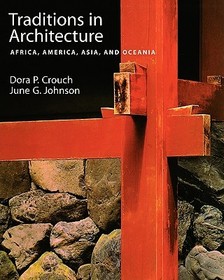
Traditions in Architecture
Africa, America, Asia, and Oceania
- Publisher's listprice GBP 54.99
-
24 827 Ft (23 645 Ft + 5% VAT)
The price is estimated because at the time of ordering we do not know what conversion rates will apply to HUF / product currency when the book arrives. In case HUF is weaker, the price increases slightly, in case HUF is stronger, the price goes lower slightly.
- Discount 10% (cc. 2 483 Ft off)
- Discounted price 22 345 Ft (21 281 Ft + 5% VAT)
Subcribe now and take benefit of a favourable price.
Subscribe
24 827 Ft

Availability
Uncertain availability. Please turn to our customer service.
Why don't you give exact delivery time?
Delivery time is estimated on our previous experiences. We give estimations only, because we order from outside Hungary, and the delivery time mainly depends on how quickly the publisher supplies the book. Faster or slower deliveries both happen, but we do our best to supply as quickly as possible.
Product details:
- Publisher OUP USA
- Date of Publication 12 October 2000
- ISBN 9780195088915
- Binding Paperback
- No. of pages448 pages
- Size 254x214x23 mm
- Weight 980 g
- Language English
- Illustrations numerous halftones and line illustrations, maps 0
Categories
Short description:
This book is a survey of traditional architectural forms by societies outside the Euro-American tradition. In order to provide a basic understanding of the cultural heritage defining these diverse groups, both vernacular and monumental works are discussed. Five broad topics - multiplicity and continuity in tradition; water, shelter, and food; purposes of architecture; planning and design; cultural values?are explored through theoretical discussions, nearly one
hundred specific examples, and 251 illustrations.
Long description:
This book introduces students, professionals and the general public to the architectural achievements of diverse cultures outside the Euro-American tradition. Rather than concentrating on geographic or chronological categories, however, the authors have arranged their subject matter thematically in order to focus on the basic needs common to all human communities.
The book is divided into five major sections, each of which deals with vernacular as well as momumental structures. These five topics are discussed in terms of particular architectural solutions, comparing and contrasting geographically separated buildings and construction traditions. For example, the issue of architectural meaning is studied through symbolic gardens in China, verbal ornament in the Islamic world, and the wall paintings of Ndebele women of southeast Africa. Theoretical issues
related to particular building traditions are illuminated by these juxtapositions.
Traditions in Architecture begins with an investigation into the ways in which the continuity of traditional forms is maintained. Next, the authors explore practical issues such as housing and food structures, climate and ecology, building materials, and architectural forms and methods. Architectural goals and purposes, which determine what is built, vary from culture to culture and are given special attention. Planning and design ? ways in which space is used in patterns of
organization ? constitute a discussion ranging from urban plans to landscaped settings. The text concludes with an examination of cultural values, investigating the interaction between architecture and social relations, traditional theories, decision-making, and the economics of building.
Table of Contents:
Introduction
Section I. Multiplicity and Continuity in Tradition
Form and Content
Transfer of Traditional Architectural Knowledge
Section II. Water, Shelter, and Food: Practial Solutions
Survival: Water, Shelter, and Food
Climate and Biology
Materials, Methods, and Architectural Form
Section III. Purposes of Traditional Architecture
Spaces for Daily Life
Religious Architecture: A Continuum of Meaning
Expression of Power
Section IV. Planning and Design
Land Use
Building Types and Uses
Organization and Structures
Section V. Cultural Types
Vernacular and Monumental Combinations
Symbolism and Ornamentation
Architecture and Social Relations
Theories of Architecture
Architectural Decision-Making
The Econmics of Building

