

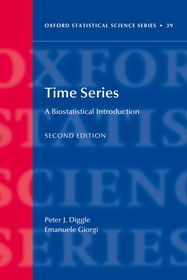
Time Series: A Biostatistical Introduction
Series: Oxford Statistical Science Series;
- Publisher's listprice GBP 40.00
-
18 060 Ft (17 200 Ft + 5% VAT)
The price is estimated because at the time of ordering we do not know what conversion rates will apply to HUF / product currency when the book arrives. In case HUF is weaker, the price increases slightly, in case HUF is stronger, the price goes lower slightly.
- Discount 10% (cc. 1 806 Ft off)
- Discounted price 16 254 Ft (15 480 Ft + 5% VAT)
Subcribe now and take benefit of a favourable price.
Subscribe
18 060 Ft

Availability
Estimated delivery time: In stock at the publisher, but not at Prospero's office. Delivery time approx. 3-5 weeks.
Not in stock at Prospero.
Why don't you give exact delivery time?
Delivery time is estimated on our previous experiences. We give estimations only, because we order from outside Hungary, and the delivery time mainly depends on how quickly the publisher supplies the book. Faster or slower deliveries both happen, but we do our best to supply as quickly as possible.
Product details:
- Edition number 2
- Publisher OUP Oxford
- Date of Publication 24 December 2024
- ISBN 9780198714842
- Binding Paperback
- No. of pages288 pages
- Size 235x160x20 mm
- Weight 488 g
- Language English 556
Categories
Short description:
A time series is a sequence of measurements on a process whose future behaviour cannot be predicted exactly from past and current observations. This book focuses on applications in the biomedical and health and sciences.
MoreLong description:
Time series analysis is one of several branches of statistics whose practical importance has increased with the availability of powerful computational tools. Methodology that was originally developed for specialized applications, for example in finance or geophysics, is now widely available within general statistical packages.
The second edition of Time Series: A Biostatistical Introduction is an introductory account of time series analysis, written from the perspective of applied statisticians whose interests lie primarily in the biomedical and health sciences. This edition has a stronger focus on substantive applications, in which each statistical analysis is directed at a specific research question. Separate chapters cover simple descriptive methods of analysis, including time-plots, smoothing, the correlogram and the periodogram; theory of stationary random processes; discrete-time models for single series; continuous-time models for single series; generalized linear models for time series of counts; models for replicated series; spectral analysis, and bivariate time series.
The book is unique in its focus on biomedical and health science applications, which has been strengthened in this second edition. Nevertheless, the methods described are more widely applicable. It should be useful to teachers and students on masters-level degree courses in statistics, biostatistics and epidemiology, and to biomedical and health scientists with a knowledge of statistical methods at undergraduate level. Throughout, examples based on real datasets show a close interplay between statistical method and substantive science. This book will also describe the implementation of the methods in the R computing environment and provide access to R code and datasets.
The book is unique in its focus on biomedical and health science applications, which has been strengthened in this second edition. Nevertheless, the methods described are more widely applicable. It should be useful to teachers and students on masters-leveldegree courses in statistics, biostatistics and epidemiology, and to biomedical and health scientists with a knowledge of statistical methods at undergraduate level.

