

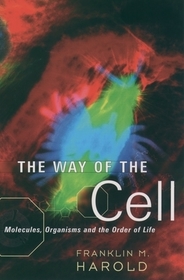
The Way of the Cell
Molecules, Organisms, and the Order of Life
- Publisher's listprice GBP 19.99
-
9 025 Ft (8 595 Ft + 5% VAT)
The price is estimated because at the time of ordering we do not know what conversion rates will apply to HUF / product currency when the book arrives. In case HUF is weaker, the price increases slightly, in case HUF is stronger, the price goes lower slightly.
- Discount 10% (cc. 903 Ft off)
- Discounted price 8 122 Ft (7 736 Ft + 5% VAT)
Subcribe now and take benefit of a favourable price.
Subscribe
9 025 Ft

Availability
printed on demand
Why don't you give exact delivery time?
Delivery time is estimated on our previous experiences. We give estimations only, because we order from outside Hungary, and the delivery time mainly depends on how quickly the publisher supplies the book. Faster or slower deliveries both happen, but we do our best to supply as quickly as possible.
Product details:
- Edition number New ed
- Publisher OUP USA
- Date of Publication 22 May 2003
- ISBN 9780195163384
- Binding Paperback
- No. of pages320 pages
- Size 235x156x23 mm
- Weight 499 g
- Language English
- Illustrations numerous line drawings and 1 table. 0
Categories
Short description:
What is life? Fifty years after physicist Erwin Schrodinger posed this question in his celebrated and inspiring book, the answer remains elusive. In The Way of the Cell, one of the world's most respected microbiologists draws on his wide knowledge of contemporary science to provide fresh insight into this intriguing and all-important question.
MoreLong description:
What is life? Fifty years after physicist Erwin Schrodinger posed this question in his celebrated and inspiring book, the answer remains elusive. In The Way of the Cell, one of the world's most respected microbiologists draws on his wide knowledge of contemporary science to provide fresh insight into this intriguing and all-important question.
What is the relationship of living things to the inanimate realm of chemistry and physics? How do lifeless but special chemicals come together to form those intricate dynamic ensembles that we recognize as life? To shed light on these questions, Franklin Harold focuses here on microorganisms - in particular, the supremely well-researched bacterium E. coli - because the cell is the simplest level of organization that manifests all the features of the phenomenon of life. Harold shows that as simple as they appear when compared to ourselves, every cell displays a dynamic pattern in space and time, orders of magnitude richer than its elements. It integrates the writhings and couplings of billions of molecules into a coherent whole, draws matter and energy into itself, constructs and reproduces its own order, and persists in this manner for numberless generations while continuously adapting to a changing world.
A cell constitutes a unitary whole, a unit of life, and in this volume one of the leading authorities on the cell gives us a vivid picture of what goes on within this minute precinct. The result is a richly detailed, meticulously crafted account of what modern science can tell us about life as well as one scientist's personal attempt to wring understanding from the tide of knowledge.
The book is erudite and scholarly; nevertheless the style is engaging and, for the informed reader, lucid ... it will stimulate any scientist who wishes to transcend the intellectual confines of her or his day-to-day work and reflect more generally on the nature of living cells ... I would recommend it to any cell biologist from senior undergraduates to Emeritus level who has a taste for philosophical reflection ... excellent value for money for the thinking cell biologist.
Table of Contents:
Preface
Acknowledgments
Schrödinger's Riddle
The Quality of Life
Cells in Nature and in Theory
Molecular Logic
A (almost) Comprehensible Cell
It Takes a Cell to Make a Cell
Morphogenesis: Where Form and Function Meet
The Advance of the Microbes
By Descent with Modification
So What is Life?
Searching for the Beginning
Epilogue
Notes
References
Glossary
Index

