

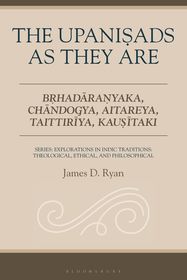
The Upanisads as They Are
Brhadaranyaka, Chandogya, Aitareya, Taittiriya, Kausitaki
Series: Explorations in Indic Traditions: Theological, Ethical, and Philosophical;
- Publisher's listprice GBP 85.00
-
38 377 Ft (36 550 Ft + 5% VAT)
The price is estimated because at the time of ordering we do not know what conversion rates will apply to HUF / product currency when the book arrives. In case HUF is weaker, the price increases slightly, in case HUF is stronger, the price goes lower slightly.
- Discount 20% (cc. 7 675 Ft off)
- Discounted price 30 702 Ft (29 240 Ft + 5% VAT)
- Discount is valid until: 30 June 2026
Subcribe now and take benefit of a favourable price.
Subscribe
38 377 Ft

Availability
Not yet published.
Why don't you give exact delivery time?
Delivery time is estimated on our previous experiences. We give estimations only, because we order from outside Hungary, and the delivery time mainly depends on how quickly the publisher supplies the book. Faster or slower deliveries both happen, but we do our best to supply as quickly as possible.
Product details:
- Publisher Bloomsbury Publishing (UK)
- Date of Publication 11 June 2026
- ISBN 9798765158975
- Binding Hardback
- No. of pages216 pages
- Size 228.6x152.4 mm
- Language English 700
Categories
Short description:
"This book reads the Upanisads ""as they are,"" emphasizing aspects of them that are often completely overlooked, among them."
MoreLong description:
"
This book argues that the early classical Upanisads constitute a ""field of wildflowers"" of insight that later Vedanta has tried to fashion into a proper garden.
These Upanisads (c. 800-300 BCE) are almost always read from the point of view of the later Vedantins, but they do not share in the neatly tailored characteristics of the mature Vedantic philosophies, representing, instead, divergent, variegated and even conflicting narratives. The author focuses on the earliest of these Upanisads: B?hadara?yaka, Chandogya, Aitareya, Taittiriya and Kau?itaki Upani?ads. These Upani?ads are read ""as they are,"" emphasizing aspects of these texts that are often completely overlooked, among them: their Vedic approach to contradiction, their frequent acceptance of means other than gnostic knowledge of or veneration of atman/brahman as a means for liberation, their positing of entities/realities other than atman or brahman as totalistic, and their frequent depiction of the human body or embodied human as a microcosm of or in identity with the universe. In course, the interpretations of the Upani?adic view, the Vedantic view, for each of these Upani?ads, of Sa?karacarya (c. 800 CE) and Ramanujacarya (c. 1100 CE), as primary examples in the range of Upani?adic interpreters, will be examined and often refuted
Table of Contents:
Preface
Abbreviations
Introduction
Chapter 1: B?hadara?yaka Upani?ad
Chapter 2: Chandogya Upani?ad
Chapter 3: Aitareya Upani?ad
Chapter 4: Taittiriya Upani?ad
Chapter 5: Kau?itaki Upani?ad
Conclusion
References
Endnotes

