

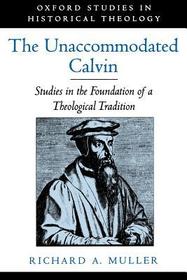
The Unaccommodated Calvin
Studies in the Foundation of a Theological Tradition
Series: Oxford Studies in Historical Theology;
- Publisher's listprice GBP 49.99
-
23 882 Ft (22 745 Ft + 5% VAT)
The price is estimated because at the time of ordering we do not know what conversion rates will apply to HUF / product currency when the book arrives. In case HUF is weaker, the price increases slightly, in case HUF is stronger, the price goes lower slightly.
- Discount 10% (cc. 2 388 Ft off)
- Discounted price 21 494 Ft (20 471 Ft + 5% VAT)
Subcribe now and take benefit of a favourable price.
Subscribe
23 882 Ft

Availability
printed on demand
Why don't you give exact delivery time?
Delivery time is estimated on our previous experiences. We give estimations only, because we order from outside Hungary, and the delivery time mainly depends on how quickly the publisher supplies the book. Faster or slower deliveries both happen, but we do our best to supply as quickly as possible.
Product details:
- Publisher OUP USA
- Date of Publication 7 March 2002
- ISBN 9780195151688
- Binding Paperback
- No. of pages324 pages
- Size 226x165x19 mm
- Weight 445 g
- Language English 0
Categories
Short description:
This book attempts to understand Calvin in his sixteenth-century context, with attention to continuities and discontinuities between his thought and that of his predecessors, contemporaries, and successors. Richard Muller is particularly interested in the interplay between theological and philosophical themes common to Calvin and the medieval doctors, and in developments in rhetoric and method associated with humanism.
MoreLong description:
This book attempts to understand Calvin in his sixteenth-century context, with attention to continuities and discontinuities between his thought and that of his predecessors, contemporaries, and successors. Richard Muller is particularly interested in the interplay between theological and philosophical themes common to Calvin and the medieval doctors, and in developments in rhetoric and method associated with humanism. He shows that Calvin's theology evidences the impact of humanist philology and rhetoric, of patristics, and also - both positively and negatively - of the categories of medieval scholastic thought. Calvin's conclusions, together with those of a group of contemporary Reformed and Lutheran thinkers, famously became the basis of much later Protestant theology. But understood in its sixteenth-century context, Muller argues, Calvin's theology proves both intriguing and intractable to twentieth-century concerns. This intractable and unaccomodated Calvin, he says, is important to our historical understanding in direct proportion to the level of distortion found in several generations of modern dogmatic analysis of Calvin's thought.
Muller's scholarship is so strong and his arguments so convincing that future Calvin scholars will only be able to ignore this book at their peril ... essential reading for anyone wishing to study Calvin's theology and exegesis, both as a model of critical historical methodology and for it's illumination of Calvin's program and the development of his thought.

