

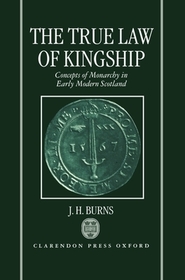
The True Law of Kingship
Concepts of Monarchy in Early-Modern Scotland
- Publisher's listprice GBP 245.00
-
110 617 Ft (105 350 Ft + 5% VAT)
The price is estimated because at the time of ordering we do not know what conversion rates will apply to HUF / product currency when the book arrives. In case HUF is weaker, the price increases slightly, in case HUF is stronger, the price goes lower slightly.
- Discount 10% (cc. 11 062 Ft off)
- Discounted price 99 556 Ft (94 815 Ft + 5% VAT)
Subcribe now and take benefit of a favourable price.
Subscribe
110 617 Ft

Availability
printed on demand
Why don't you give exact delivery time?
Delivery time is estimated on our previous experiences. We give estimations only, because we order from outside Hungary, and the delivery time mainly depends on how quickly the publisher supplies the book. Faster or slower deliveries both happen, but we do our best to supply as quickly as possible.
Product details:
- Publisher Clarendon Press
- Date of Publication 11 January 1996
- ISBN 9780198203841
- Binding Hardback
- No. of pages332 pages
- Size 225x143x24 mm
- Weight 579 g
- Language English 0
Categories
Short description:
`Fear God, honour the king.' Sixteenth-century people were supposed to do both. But what was the king entitled to command? And what if he ordered one thing and God's law said another? In this fascinating and original study, James Burns examines these questions by focusing on a neglected area of study: sixteenth-century Scotland. The Scottish response to monarchical government not only provides a microcosmic view of European thinking on the subject, it also contributes substantially to our understanding of the Scottish element in the new `British' polity which was emerging at the end of the period.
MoreLong description:
`Fear God, honour the king'. Sixteenth-century people were supposed to do both. But what was the king entitled to command? And what if he ordered one thing and God's law said another? In this fascinating and original study, James Burns examines these questions by focusing on a neglected area of study: the Scottish experience. Sixteenth-century Scots lived through intense political and religious conflict, which generated a substantial literature of political debate. This debate was of such an intensity that James VI, the first king to rule over Scotland and England, wrote his own book on the subject: The True Lawe of Free Monarchies
Some of the substantial literature of political debate has long been recognized as important in the wider history of European political thought. Knox and Buchanan as exponents of 'resistance theory', Blackwood and Barclay as defenders of 'absolute' monarchy, have had that recognition. James VI uniquely expounding 'divine right' principles from the throne, has likewise had his place. More recently, the significance of the late-scholastic theory of John Mair has been increasingly acknowledged. This book, however, is the first attempt to bring together systematically these and less familiar elements in a rich and varied body of political thought. The Scottish response to monarchical government not only provides a microcosmic view of European thinking on the subject, it also contributes substantially to our understanding of the Scottish element in the new `British' polity which was emerging at the end of the period.
a significant and thoughtful result of many years of research and writing devoted to the history and development of Scottish speculation on the nature of monarchy ... contributes to a significant change in the historiographical outlook toward early modern Scottish history that has characterized the scholarly work of the past generation of Scottish academic writers ... a learned pioneering study.

