

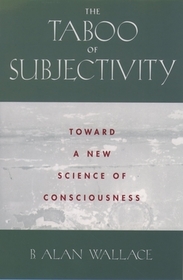
The Taboo of Subjectivity
Towards a New Science of Consciousness
- Publisher's listprice GBP 42.99
-
19 409 Ft (18 485 Ft + 5% VAT)
The price is estimated because at the time of ordering we do not know what conversion rates will apply to HUF / product currency when the book arrives. In case HUF is weaker, the price increases slightly, in case HUF is stronger, the price goes lower slightly.
- Discount 10% (cc. 1 941 Ft off)
- Discounted price 17 468 Ft (16 637 Ft + 5% VAT)
Subcribe now and take benefit of a favourable price.
Subscribe
19 409 Ft

Availability
printed on demand
Why don't you give exact delivery time?
Delivery time is estimated on our previous experiences. We give estimations only, because we order from outside Hungary, and the delivery time mainly depends on how quickly the publisher supplies the book. Faster or slower deliveries both happen, but we do our best to supply as quickly as possible.
Product details:
- Publisher OUP USA
- Date of Publication 4 March 2004
- ISBN 9780195173109
- Binding Paperback
- No. of pages323 pages
- Size 232x155x17 mm
- Weight 363 g
- Language English 0
Categories
Long description:
This book takes a bold new look at ways of exploring the nature, origins, and potentials of consciousness within the context of science and religion. Alan Wallace draws careful distinctions between four elements of the scientific tradition: science itself, scientific realism, scientific materialism, and scientism. Arguing that the metaphysical doctrine of scientific materialism has taken on the role of ersatz-religion for its adherents, he traces its development from its Greek and Judeo-Christian origins, focusing on the interrelation between the Protestant Reformation and the Scientific Revolution. He looks at scientists' long term resistance to the firsthand study of consciousness and details the ways in which subjectivity has been deemed taboo within the scientific community. In conclusion, Wallace draws on William James's idea for a "science of religion" that would study the nature of religious and, in particular, contemplative experience.
In exploring the nature of consciousness, this groundbreaking study will help to bridge the chasm between religious belief and scientific knowledge. It is essential reading for philosophers and historians of science, scholars of religion, and anyone interested in the relationship between science and religion.
Wallace has looked carefully at the religious study of consciousness in both East and West, and no one can walk away from this book without a deeper impression of the profound understanding of religious consciousness that religious thinkers and traditions have achieved. The book will thus be welcomed by those who are interested in the phenomenology of religious consciousness as a tool for the cross-cultural study of religious phenomena. For these purposes it is heartily recommended.--The Journal of the American Academy of Religion

