

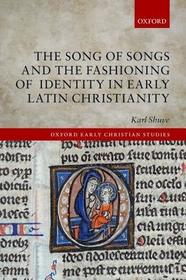
The Song of Songs and the Fashioning of Identity in Early Latin Christianity
Series: Oxford Early Christian Studies;
- Publisher's listprice GBP 117.50
-
53 051 Ft (50 525 Ft + 5% VAT)
The price is estimated because at the time of ordering we do not know what conversion rates will apply to HUF / product currency when the book arrives. In case HUF is weaker, the price increases slightly, in case HUF is stronger, the price goes lower slightly.
- Discount 10% (cc. 5 305 Ft off)
- Discounted price 47 746 Ft (45 473 Ft + 5% VAT)
Subcribe now and take benefit of a favourable price.
Subscribe
53 051 Ft

Availability
printed on demand
Why don't you give exact delivery time?
Delivery time is estimated on our previous experiences. We give estimations only, because we order from outside Hungary, and the delivery time mainly depends on how quickly the publisher supplies the book. Faster or slower deliveries both happen, but we do our best to supply as quickly as possible.
Product details:
- Publisher OUP Oxford
- Date of Publication 24 March 2016
- ISBN 9780198766445
- Binding Hardback
- No. of pages258 pages
- Size 241x162x20 mm
- Weight 504 g
- Language English 0
Categories
Short description:
Dr Shuve offers a comprehensive analysis of the interpretation of the Song of Songs in the Latin-speaking churches of Late Antiquity, showing how it was used by bishops and theologians to illuminate complex problems of identity in relation to liturgical practice, doctrinal definitions, and ideas about the body and sexuality.
MoreLong description:
In this work, Karl Shuve provides a new account of how the Song of Songs became one of the most popular biblical texts in medieval Western Christianity, through a close and detailed study of its interpretation by late antique Latin theologians. It has often been presumed that early Latin writers exercised little influence on the medieval interpretation of the poem, since there are so few extant commentaries from the period. But this is to overlook the hundreds of citations of and allusions to the Song in the writings of influential figures such as Cyprian, Ambrose, Jerome, and Augustine as well as the lesser-known theologian Gregory of Elvira. Through a comprehensive analysis of these citations and allusions, Shuve argues that contrary to the expectations of many modern scholars, the Song of Songs was not a problematic text for early Christian theologians, but was a resource that they mined as they debated the nature of the church and of the virtuous life. The first part of the volume considers the use of the Song in the churches of Roman Africa and Spain, where bishops and theologians focused on images of enclosure and purity invoked in the poem. In the second part, the focus is late fourth-century Italy, where a new ascetic interpretation, concerned particularly with women's piety, began to emerge. This erotic poem gradually became embedded in the discursive traditions of Latin Late Antiquity, which were bequeathed to the Christian communities of early medieval Europe.
Shuve's fine study - detailed, scholarly and smoothly-written - opens new vistas on the multifarious uses to which the Song of Songs could be put in late ancient Latin Christianity.
Table of Contents:
Abbreviations
Introduction
The Song of Songs in North Africa and Spain
'A Garden Enclosed, A Fountain Sealed': The Church as Closed Community in Cyprian and the Donatists
1. 'As a Lily Among the Thorns': The Church as Mixed Community in Pacian, Tyconius, and Augustine
1. 'The Church is the Flesh of Christ': The Tractatus de Epithalamio of Gregory of Elivra
The Song of Songs in Italy
'Like the Holy Church, Unsullied by Intercourse': Ambrose, Virgins, and the Song
'For Souls Know Not Covenants of Wedlock': Ascetic Ideology and Mystical Theology in Ambrose's Later Works
'This Book Contains the Mysteries of Virginity': Jerome and the Making of Ascetic Community
Epilogue: Towards Medieval Exegesis

