
• Contact

  • Newsletter

  • About us

  • Delivery options

  • Prospero Book Market Podcast

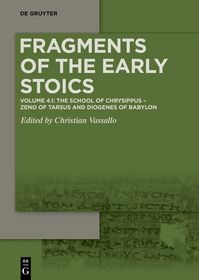
  • The School of Chrysippus – Zeno of Tarsus and Diogenes of Babylon: Testimonies and Fragments

    The School of Chrysippus – Zeno of Tarsus and Diogenes of Babylon by Vassallo, Christian;

    Testimonies and Fragments

      • GET 5% OFF

      • The discount is only available for 'Alert of Favourite Topics' newsletter recipients.
      • Publisher's listprice EUR 149.95
      • The price is estimated because at the time of ordering we do not know what conversion rates will apply to HUF / product currency when the book arrives. In case HUF is weaker, the price increases slightly, in case HUF is stronger, the price goes lower slightly.

        58 570 Ft (55 781 Ft + 5% VAT)
      • Discount 5% (cc. 2 929 Ft off)
      • Discounted price 55 642 Ft (52 992 Ft + 5% VAT)

    58 570 Ft

    db

    Availability

    Not yet published.

    Why don't you give exact delivery time?

    Delivery time is estimated on our previous experiences. We give estimations only, because we order from outside Hungary, and the delivery time mainly depends on how quickly the publisher supplies the book. Faster or slower deliveries both happen, but we do our best to supply as quickly as possible.

    Product details:

    • Edition number 1
    • Publisher De Gruyter
    • Date of Publication 22 June 2026

    • ISBN 9783111426952
    • Binding Hardback
    • No. of pages825 pages
    • Size 240x170 mm
    • Weight 500 g
    • Language English
    • Illustrations 1 Line drawings, black & white
    • 700

    Categories

    Long description:

    Diogenes of Babylon, also known as Diogenes of Seleucia, was a pupil of Chrysippus and, after Zeno of Tarsus, the fifth head of the Stoic school in Athens, serving until his death, with Antipater of Tarsus and Panaetius among his students. The dates of his birth and death remain uncertain (ca. 238/228–150/140 BCE). Together with the Academic Carneades and the Peripatetic Critolaus, he participated in the embassy of philosophers sent to Rome to petition for the abolition of the 500-talent fine imposed on Athens for the sack of Oropos. From the key information about his surviving treatises, we know that their subjects can be traced back to the three parts into which Diogenes of Babylon divided philosophy — namely, logic, physics, and ethics — as Zeno of Citium had also done.

    One of the greatest difficulties in reconstructing his thought lies in its transmission: almost 80% of the testimonies about him, collected by von Arnim (SVF III, pp. 210–43 = frs. 1–126), are preserved in the papyri, especially the Herculaneum papyri, sometimes in rolls that have awaited a new critical edition for over a century. About 120 years after the publication of the Stoicorum Veterum Fragmenta, this volume, after critically collecting the scanty evidence for Zeno of Tarsus, presents a new systematic and comprehensive edition of the fragments of Diogenes of Babylon, with an introduction, a translation, and a running commentary. The collection increases by more than a half the number of known testimonies considered by von Arnim.

    This enterprise will significantly enhance our knowledge of the final stage of the early Stoa and its relation to the rival schools of Hellenistic philosophy. Most importantly, the volume brings to the fore one of the greatest and most revolutionary figures in the history of ancient philosophy, so far undeservedly neglected, whose doctrines contributed substantially to the development of logic, linguistics, ontology, and ethics in the Western thought.

    More
    0