

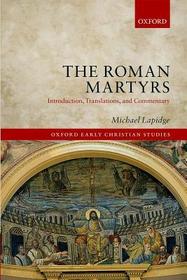
The Roman Martyrs
Introduction, Translations, and Commentary
Series: Oxford Early Christian Studies;
- Publisher's listprice GBP 227.50
-
102 716 Ft (97 825 Ft + 5% VAT)
The price is estimated because at the time of ordering we do not know what conversion rates will apply to HUF / product currency when the book arrives. In case HUF is weaker, the price increases slightly, in case HUF is stronger, the price goes lower slightly.
- Discount 10% (cc. 10 271 Ft off)
- Discounted price 92 445 Ft (88 043 Ft + 5% VAT)
Subcribe now and take benefit of a favourable price.
Subscribe
102 716 Ft

Availability
printed on demand
Why don't you give exact delivery time?
Delivery time is estimated on our previous experiences. We give estimations only, because we order from outside Hungary, and the delivery time mainly depends on how quickly the publisher supplies the book. Faster or slower deliveries both happen, but we do our best to supply as quickly as possible.
Product details:
- Publisher OUP Oxford
- Date of Publication 14 December 2017
- ISBN 9780198811367
- Binding Hardback
- No. of pages750 pages
- Size 237x164x46 mm
- Weight 1260 g
- Language English 0
Categories
Short description:
This volume contains translations of forty Latin passiones of saints who were martyred in Rome or its near environs, during the period before the 'peace of the Church' (c. 312). Each translation is accompanied by an individual introduction and commentary.
MoreLong description:
The Roman Martyrs contains translations of forty Latin passiones of saints who were martyred in Rome or its near environs, during the period before the 'peace of the Church' (c. 312). Some of the Roman martyrs are universally known-SS. Agnes, Sebastian or Laurence, for example-but others are scarcely recognized outside the ecclesiastical landscape of Rome itself. Each of the translated passiones is accompanied by an individual introduction and commentary; the translations are preceded by an Introduction which describes the principal features of this little-known genre of Christian literature, and are followed by five Appendices which present translated texts which are essential for understanding the cult of Roman martyrs.
This volume offers the first collection of the Roman passiones martyrum translated into a modern language. They were mostly composed during the period 425-675, by anonymous authors who were presumably clerics of the Roman churches or cemeteries which housed the martyrs' remains. It is clear that they were composed in response to the explosion of pilgrim traffic to martyrial shrines from the late fourth century onwards, at a time when authentic records (protocols) of their trials and executions had long since vanished, and the authors of the passiones were obliged to imagine the circumstances in which martyrs were tried and executed. The passiones are works of fiction; and because they abound in ludicrous errors of chronology, they have been largely ignored by historians of the early Church. Although they cannot be used as evidence for the original martyrdoms, they nevertheless allow a fascinating glimpse of the concerns which animated Christians during the period in question: for example, the preservation of virginity, or the ever-present threat posed by pagan practices. As certain aspects of Roman life will have changed little between the second century and the fifth, the passiones shed valuable light on many aspects of Roman society, not least the nature of a trial before an urban prefect, and the horrendous tortures which were a central feature of such trials. The passiones are an indispensable resource for understanding the topography of late antique Rome and its environs, as they characteristically contain detailed reference to the places where the martyrs were tried, executed, and buried.
Lapidge has made an inestimable contribution to Early Church studies. The work captures the ecclesiastical ethos at the time of the passions, both in Christian values and the counter-values of paganism... the collection of information about each martyr, source and hagiography is unparalleled. Most important, the author provides martyrdom accounts in English of the hagiography still dominating the landscape of ecclesiastical Rome.
Table of Contents:
Abbreviations
Map 1. The intra-urban churches dedicated to Roman martyrs
Map 2. Suburban cemeteries housing shrines to Roman martyrs
Introduction
TEXTS AND COMMENTARIES
I. St Felicitas and her seven sons
II. SS. Anastasia, Chrysogonus and companions
III. St Sebastian and companions
IV. St Caecilia and companions
V. Pope Clement
VI. SS. Sixtus, Laurence, and Hippolytus (passio vetus)
VII. Pope Cornelius
VIII. SS. Nereus and Achilleus and companions
IX. SS. Eugenia, Protus and Hyacinthus
X. SS. Chrysanthus and Daria
XI. St Susanna
XII. Pope Callistus
XIII. St Eusebius the priest
XIV. Pope Felix II
XV. SS. Pudentiana and Praxedis
XVI. SS. Polychronius and Parmenius, Abdon and Sennes, Pope Sixtus II, Laurence, and Hippolytus
XVII. SS. Agnes and Emerentiana
XVIII. SS. Gallicanus, John and Paul
XIX. SS. Processus and Martinianus
XX. Pope Marcellus and companions
XXI. SS. Primus and Felicianus
XXII. SS. Marius and Martha
XXIII. SS. Marcellinus and Peter
XXIV. The Four Crowned Martyrs
XXV. St Pancratius
XXVI. Pope Stephen
XXVII. SS. Gordianus and Epimachus
XXVIII. The Greek Martyrs
XXIX. SS. Eusebius and Pontianus
XXX. Pope Urban
XXXI. SS. Rufina and Secunda
XXXII. SS. Alexander, Eventius and Theodulus
XXXIII. SS. Calogerus and Parthenius
XXXIV. SS. Serapia and Sabina
XXXV. SS. Felix and Adauctus
XXXVI. SS. Simplicius, Faustinus and Beatrix
XXXVII. St Symphorosa and her seven sons
XXXVIII. St Pigmenius
XXXIX. St Getulius
XL. St Basilides
Appendix I: THE DEPOSITIO MARTYRVM (A.D. 354)
Appendix II: THE EPIGRAMMATA OF DAMASUS
Appendix III: ROMAN MARTYRS IN THE MARTYROLOGIVM
Appendix IV: SEVENTH-CENTURY PILGRIM ITINERARIES TO ROMAN CHURCHES AND CEMETERIES
Appendix V: THE COMMEMORATION OF ROMAN MARTYRS IN EARLY ROMAN LITURGICAL BOOKS
Glossary
Bibliography

