

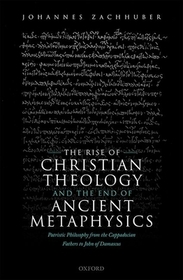
The Rise of Christian Theology and the End of Ancient Metaphysics
Patristic Philosophy from the Cappadocian Fathers to John of Damascus
- Publisher's listprice GBP 120.00
-
54 180 Ft (51 600 Ft + 5% VAT)
The price is estimated because at the time of ordering we do not know what conversion rates will apply to HUF / product currency when the book arrives. In case HUF is weaker, the price increases slightly, in case HUF is stronger, the price goes lower slightly.
- Discount % (cc. 0 Ft off)
- Discounted price 0 Ft (0 Ft + 5% VAT)
Subcribe now and take benefit of a favourable price.
Subscribe
54 180 Ft

Availability
Estimated delivery time: In stock at the publisher, but not at Prospero's office. Delivery time approx. 3-5 weeks.
Not in stock at Prospero.
Why don't you give exact delivery time?
Delivery time is estimated on our previous experiences. We give estimations only, because we order from outside Hungary, and the delivery time mainly depends on how quickly the publisher supplies the book. Faster or slower deliveries both happen, but we do our best to supply as quickly as possible.
Product details:
- Publisher OUP Oxford
- Date of Publication 29 May 2020
- ISBN 9780198859956
- Binding Hardback
- No. of pages370 pages
- Size 235x162x25 mm
- Weight 684 g
- Language English 0
Categories
Short description:
It has rarely been recognized that the Christian writers of the first millennium pursued an ambitious and exciting philosophical project alongside their engagement in the doctrinal controversies of their age. This book offers a full analysis of this Patristic philosophy until the time of John of Damascus.
MoreLong description:
It has rarely been recognized that the Christian writers of the first millennium pursued an ambitious and exciting philosophical project alongside their engagement in the doctrinal controversies of their age. The Rise of Christian Theology and the End of Ancient Metaphysics offers, for the first time, a full analysis of this Patristic philosophy. It shows how it took its distinctive shape in the late fourth century and gives an account of its subsequent development until the time of John of Damascus.
The book falls into three main parts. The first starts with an analysis of the philosophical project underlying the teaching of the Cappadocian fathers, Basil of Caesarea, Gregory of Nyssa and Gregory of Nazianzus. This philosophy, arguably the first distinctively Christian theory of being, soon became near-universally shared in Eastern Christianity. Just a few decades after the Cappadocians, all sides in the early Christological controversy took its fundamental tenets for granted. Its application to the Christological problem thus appeared inevitable. Yet it created substantial conceptual problems.
Parts two and three describe in detail how these problems led to a series of increasingly radical modifications of the Cappadocian philosophy. In part two, Zachhuber explores the miaphysite opponents of the Council of Chalcedon, while in part three he discusses the defenders of the Council from the early sixth to the eighth century. Through this overview, the book reveals this period as one of remarkable philosophical creativity, fecundity, and innovation.
This excellent book provides a thorough study-to my knowledge, the first of its kind-of the philosophical dimension of Christian doctrine in late antiquity...I think, the most important book on early Christian doctrine in the past decade or more. It is clearly written, though conceptually demanding, and thereby provides a needed model for how to study dogmatic theology's complex philosophical underpinnings.
Table of Contents:
Introduction
Part I: The Rise of the Classical Theory
The Cappadocians and their Christian Philosophy
The Rise of the Classical Theory and the Challenge of Christology
Part II: The case against Chalcedon
Severus of Antioch: A conservative revolutionary
John Philoponus: Energetic revision of the classical theory
Damian of Alexandria and Peter of Callinicus: Miaphysite antitritheism
Part III: Chalcedonian Transformations of the Cappadocian Theory
Laying the Foundations: John the Grammarian and Leontius of Byzantium
From the Council of Constantinople to the Monenergist Controversy
The Climax of Chalcedonian Philosophy
Conclusion: Patristic Philosophy and its Nachleben

