

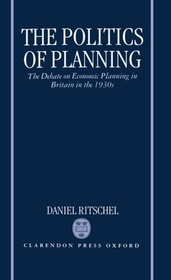
The Politics of Planning
The Debate on Economic Planning in Britain in the 1930s
Series: Oxford Historical Monographs;
- Publisher's listprice GBP 59.00
-
26 638 Ft (25 370 Ft + 5% VAT)
The price is estimated because at the time of ordering we do not know what conversion rates will apply to HUF / product currency when the book arrives. In case HUF is weaker, the price increases slightly, in case HUF is stronger, the price goes lower slightly.
- Discount 10% (cc. 2 663 Ft off)
- Discounted price 23 975 Ft (22 833 Ft + 5% VAT)
Subcribe now and take benefit of a favourable price.
Subscribe
26 638 Ft

Availability
printed on demand
Why don't you give exact delivery time?
Delivery time is estimated on our previous experiences. We give estimations only, because we order from outside Hungary, and the delivery time mainly depends on how quickly the publisher supplies the book. Faster or slower deliveries both happen, but we do our best to supply as quickly as possible.
Product details:
- Publisher OUP Oxford
- Date of Publication 10 July 1997
- ISBN 9780198206477
- Binding Hardback
- No. of pages384 pages
- Size 225x144x26 mm
- Weight 593 g
- Language English 0
Categories
Short description:
The concept of `economic planning' was a central theme of the popular economic policy debate in the 1930s. Dr Ritschel traces the many interpretations of planning, and examines the process of idealogical construction and dissemination of the new economic ideas. He finishes with an explanation of the planners' retreat, later in the decade, from the economics of planning towards the far less ambitious (but also less contentious) alternative - the `middle way' of Keynesian economics.
MoreLong description:
The idea of `economic planning' was a central theme of the radical economic policy debate in the 1930s. Born of the inter-war economic crisis, the call for the reconstruction of the economy according to a `plan' of one kind or another spanned practically the entire spectrum of the politics of the day. The fashion for planning is often seen as the seedbed of the Keynesian revolution and the `Butskellite' consensus of thenext decade. Yet `planning' was neither uniformly Keynesian nor, in fact, indicative of political agreement over economic policy. Beneath the shared language of planning, the radical economic debate was riven by the same ideological rifts which dominated the more conventional political scene. Dr Ritschel traces the many interpretations of planning, and examines the process of ideological construction and dissemination of the new economic ideas. He finishes with an explanation of the planners' retreat, late in the decade, from the divisive economics of planning towards the less ambitious but also far less contentious alternative - the `middle way' of Keynesian economics.
an appealing and well-made argument

