

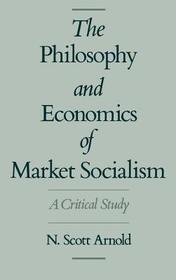
The Philosophy and Economics of Market Socialism
A Critical Study
- Publisher's listprice GBP 73.00
-
32 959 Ft (31 390 Ft + 5% VAT)
The price is estimated because at the time of ordering we do not know what conversion rates will apply to HUF / product currency when the book arrives. In case HUF is weaker, the price increases slightly, in case HUF is stronger, the price goes lower slightly.
- Discount 10% (cc. 3 296 Ft off)
- Discounted price 29 664 Ft (28 251 Ft + 5% VAT)
Subcribe now and take benefit of a favourable price.
Subscribe
32 959 Ft

Availability
printed on demand
Why don't you give exact delivery time?
Delivery time is estimated on our previous experiences. We give estimations only, because we order from outside Hungary, and the delivery time mainly depends on how quickly the publisher supplies the book. Faster or slower deliveries both happen, but we do our best to supply as quickly as possible.
Product details:
- Publisher OUP USA
- Date of Publication 18 May 1995
- ISBN 9780195088274
- Binding Hardback
- No. of pages320 pages
- Size 244x163x27 mm
- Weight 630 g
- Language English 0
Categories
Short description:
The Philosophy and Economics of Market Socialism offers a comparative evaluation of market socialism and a free enterprise system. It argues that a market socialist system would be responsible for widespread and systematic exploitation that is precluded or minimized in a free enterprise system. This analysis draws on recent work on the economics of contracts and organizations. Arnold locates his analysis in the larger context of the capitalism/socialism debate.
MoreLong description:
N. Scott Arnold argues that the most defensible version of a market socialist economic system would be unable to realize widely held socialist ideals and values. In particular, it would be responsible for widespread and systematic exploitation. The charge of exploitation, which is really a charge of injustice, has typically been made against capitalist systems by socialists. This book argues that it is market socialism--the only remaining viable form of socialism--that is systematically exploitative. Recent work on the economics of contracts and organizations is used to show that the characteristic organizations of a free enterprise system, the classical capitalist firm and the modern corporation, are structured in such a way that opportunities for exploitation among economic actors (e.g., managers, workers, providers of capital, customers) are minimized. By contrast, Arnold argues, in a market socialist regime of worker cooperatives, opportunities for exploitation would abound. Arnold locates his comparative analysis of market socialism and the free enterprise system in the larger context of the capitalism/socialism debate. In his account of this debate, he offers a distinctive and compelling vision of the relationship between the social sciences and political philosophy.
N. Scott Arnold's outstanding book makes a vital contribution to the debate over socialism; ...Arnold's discussion is a first-rate achievement. He has provided the best and most carefully worked out account of market socialism that I have read. His book is a model of how philosophers can use economic theory in their work--and in this department there can be no doubt of Arnold's efficiency.

