

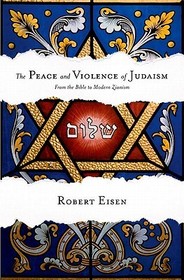
The Peace and Violence of Judaism
From the Bible to Modern Zionism
- Publisher's listprice GBP 45.99
-
20 764 Ft (19 775 Ft + 5% VAT)
The price is estimated because at the time of ordering we do not know what conversion rates will apply to HUF / product currency when the book arrives. In case HUF is weaker, the price increases slightly, in case HUF is stronger, the price goes lower slightly.
- Discount 10% (cc. 2 077 Ft off)
- Discounted price 18 687 Ft (17 798 Ft + 5% VAT)
Subcribe now and take benefit of a favourable price.
Subscribe
20 764 Ft

Availability
printed on demand
Why don't you give exact delivery time?
Delivery time is estimated on our previous experiences. We give estimations only, because we order from outside Hungary, and the delivery time mainly depends on how quickly the publisher supplies the book. Faster or slower deliveries both happen, but we do our best to supply as quickly as possible.
Product details:
- Publisher OUP USA
- Date of Publication 24 February 2011
- ISBN 9780199751471
- Binding Hardback
- No. of pages280 pages
- Size 236x157x27 mm
- Weight 499 g
- Language English 0
Categories
Short description:
Robert Eisen provides the first comprehensive analysis of Jewish views on peace and violence, demonstrating that Judaism has exhibited ambiguity on this theme throughout its history, and exploring why that ambiguity exists. This study will be of interest not only to students of Judaism but to students of all religious traditions.
MoreLong description:
Robert Eisen provides the first comprehensive analysis of Jewish views on peace and violence, examining five major sources of Jewish thought - the Bible, rabbinic Judaism, medieval Jewish philosophy, Kabbalah, and modern Zionism. He demonstrates that throughout its history Judaism has consistently exhibited ambiguity regarding peace and violence. To make his case, Eisen presents two separate analyses for each of the areas he examines: one that argues for a peaceful reading of Judaism, and another that argues for a violent reading. The aim is to show that both readings are valid and authentic interpretations of Judaism. Eisen also explores why Judaism can be read both ways by examining the interpretive techniques that support each reading.
This study should be of interest not just to students of Judaism, but to students of all religious traditions: the ambiguity concerning violence in Judaism is true of many other religions as well. Eisen's study therefore provides a model for analyzing peace and violence in religion in general.
This innovative exploration of the potential for the promotion of both peace and violence within Judaism arising from its inherent ambiguities leads Eisen to a thought-provoking consideration of constructive ethics and his conclusion that pragmatic concerns might legitimately be considered alongside the textual evidence in accepting a reading that Judaism inspires and promotes peace rather than violence.
Table of Contents:
INTRODUCTION
THE BIBLE
RABBINIC JUDAISM
MEDIEVAL JEWISH PHILOSOHY
KABBALAH
MODERN ZIONISM
CONCLUSIONS
EPILOGUE: PERSONAL REFLECTIONS ON
WHERE WE GO FROM HERE
WORKS CITED

