

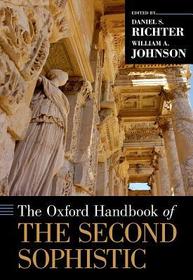
The Oxford Handbook of the Second Sophistic
Series: Oxford Handbooks;
- Publisher's listprice GBP 162.50
-
77 634 Ft (73 937 Ft + 5% VAT)
The price is estimated because at the time of ordering we do not know what conversion rates will apply to HUF / product currency when the book arrives. In case HUF is weaker, the price increases slightly, in case HUF is stronger, the price goes lower slightly.
- Discount 10% (cc. 7 763 Ft off)
- Discounted price 69 870 Ft (66 543 Ft + 5% VAT)
Subcribe now and take benefit of a favourable price.
Subscribe
77 634 Ft

Availability
printed on demand
Why don't you give exact delivery time?
Delivery time is estimated on our previous experiences. We give estimations only, because we order from outside Hungary, and the delivery time mainly depends on how quickly the publisher supplies the book. Faster or slower deliveries both happen, but we do our best to supply as quickly as possible.
Product details:
- Publisher OUP USA
- Date of Publication 21 December 2017
- ISBN 9780199837472
- Binding Hardback
- No. of pages776 pages
- Size 175x249x53 mm
- Weight 1420 g
- Language English 80
Categories
Short description:
Focusing on the period known as the Second Sophistic, this Handbook offers guidance on the wide range of textual materials that survive, many of which are useful or even core to inquiries of particularly current interest, while also keeping a sharp focus on how we can best situate these texts within the broader socio-cultural milieu.
MoreLong description:
Focusing on the period known as the Second Sophistic (an era roughly co-extensive with the second century AD), this Handbook serves the need for a broad and accessible overview. The study of the Second Sophistic is a relative new-comer to the Anglophone field of classics and much of what characterizes it temporally and culturally remains a matter of legitimate contestation. The present Handbook offers a diversity of scholarly voices that attempt to define, as much as is possible in a single volume, the state of this rapidly developing field. Included are chapters that offer practical guidance on the wide range of valuable textual materials that survive, many of which are useful or even core to inquiries of particularly current interest (e.g. gender studies, cultural history of the body, sociology of literary culture, history of education and intellectualism, history of religion, political theory, history of medicine, cultural linguistics, intersection of the Classical traditions and early Christianity). The Handbook also contains essays devoted to the work of the most significant intellectuals of the period such as Plutarch, Dio Chrysostom, Lucian, Apuleius, the novelists, the Philostrati and Aelius Aristides. In addition to content and bibliographical guidance, however, this volume is designed to help to situate the textual remains within the period and its society, to describe and circumscribe not simply the literary matter but the literary culture and societal context. For that reason, the Handbook devotes considerable space at the front to various contextual essays, and throughout tries to keep the contextual demands in mind. In its scope and in its pluralism of voices this Handbook thus represents a new approach to the Second Sophistic, one that attempts to integrate Greek literature of the Roman period into the wider world of early imperial Greek, Latin, Jewish, and Christian cultural production, and one that keeps a sharp focus on situating these texts within their socio-cultural context.
... this handbook covers an unusually wide range of topics that are relevant to Hellenic culture under Rome in the first three centuries AD. Those teaching courses on any aspect of this period will consult the volume with much benefit and might even consider putting selected chapters on the syllabus.
Table of Contents:
I. Introductory
Periodicity and Scope
Greece: Hellenistic and Early Imperial Continuities
Was There a Latin Second Sophistic?
II. Language and Identity
Atticism and Asianism
Latinitas
Cosmopolitanism
Ethnicity, Culture and Identity
Retrosexuality: Sex in the Second Sophistic
III. Paideia and Performance
Schools and Paideia
Athletes and Trainers
Professionals of Paideia? The Sophists as Performers
Performance Space
IV. Rhetoric and Rhetoricians
Greek and Latin Rhetorical Culture
Dio Chrysostom
Favorinus and Herodes Atticus
Fronto and his Circle
Aelius Aristides
V. Literature and Culture
Philostratus
Plutarch: Philosophy, Religion, and EthicsFred Brenk
Plutarch's Lives
Lucian of Samosata
Apuleius
Pausanias
Galen
Chariton and Xenophon of Ephesus
Longus and Achilles Tatius
The Anti-Sophistic Novel
Miscellanies
Mythography
Historiography
Poets and Poetry
Epistolography
VI. Philosophy and Philosophers
The Stoics
Epic ureanism Writ Large: Diogenes of OenoandaPamela Gordon
Skepticism
Platonism
The Aristotelian Tradition
VII. Religion and Religious Literature
Cult
Pilgrimage
Early Christianity and the Classical TraditionAaron P. Johnson
Jewish Literature
The Creation of Christian Elite Culture in Roman Syria and the Near East
Christian Apocrypha

